
Simple Past (Präteritum) — The Written Past 📜✍️
The Simple Past (Präteritum) is mostly reserved for formal writing, news reports, and literature. However, three crucial exceptions exist: the verbs sein (war), haben (hatte), and the modal verbs. These are commonly used in the simple past even in daily speech.
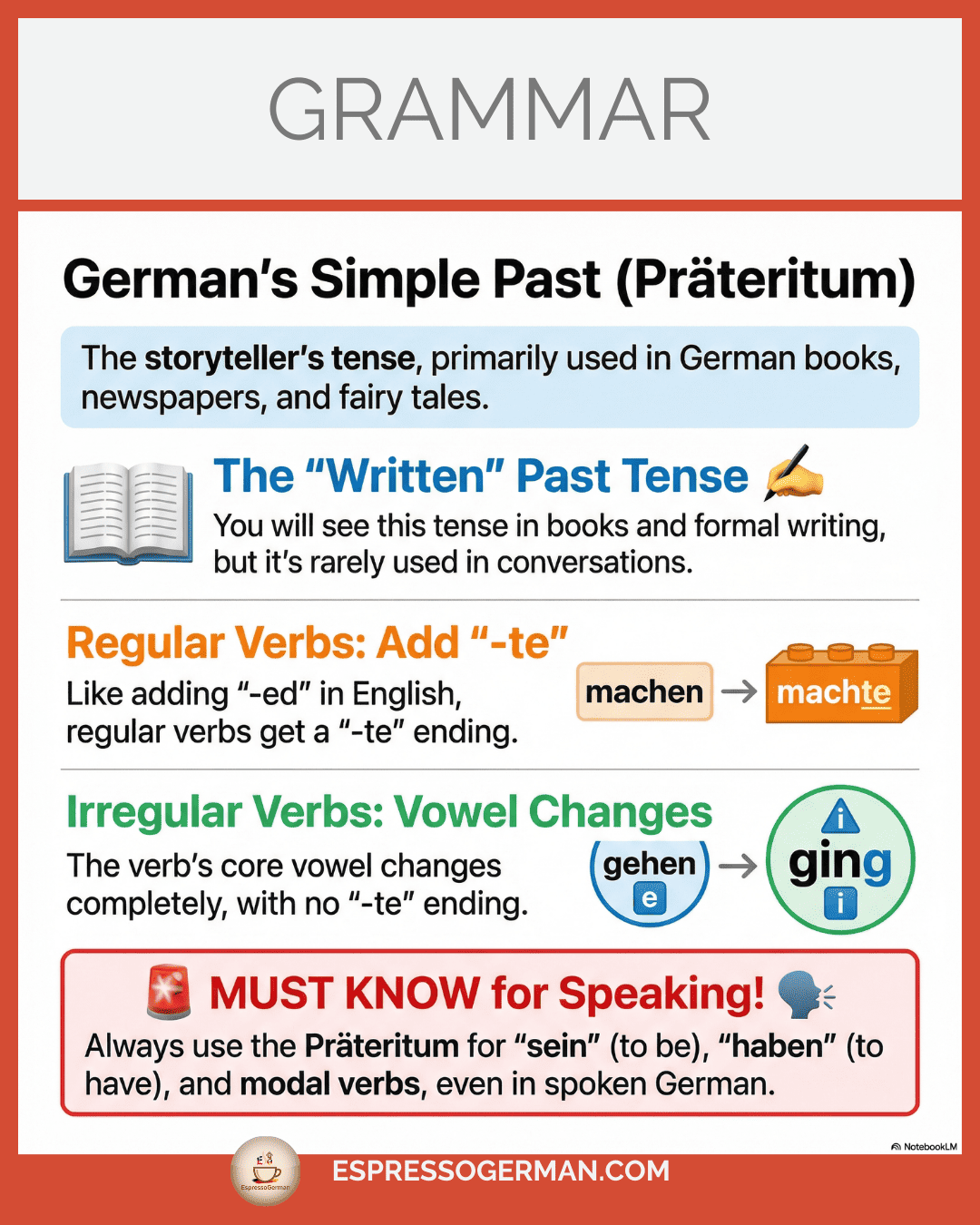
The Präteritum is the storyteller's tense.
You will see it in books, newspapers, and fairy tales.
"Es war einmal eine Prinzessin..." (Once upon a time there was a princess).
In spoken German, we rarely use it.
EXCEPTION: We DO use it for Sein, Haben, and Modal Verbs in speech!
1. The Regulars (The "-te" Army) 🤖
For regular verbs (machen, sagen, spielen), we adds -te endings.
It looks like the English "-ed".
| Person | Ending | Example (sagen) |
|---|---|---|
| ich | -te | ich sagte (I said) |
| du | -test | du sagtest |
| er/sie/es | -te | er sagte |
| wir | -ten | wir sagten |
| ihr | -tet | ihr sagtet |
| sie/Sie | -ten | sie sagten |
[!NOTE]
Examples:
- Ich machte das Fenster auf. (I opened the window).
- Wir spielten Fußball. (We played football).
2. The Irregulars (Stem Changers) 🧟♂️
Strong verbs change their vowel. They don't use "-te". They just change the stem and add personal endings (except 1st/3rd singular).
- gehen ➔ ging
- sehen ➔ sah
- kommen ➔ kam
| Person | Example (gehen ➔ ging) |
|---|---|
| ich | ich ging (No ending!) |
| du | du gingst |
| er/sie/es | er ging (No ending!) |
| wir | wir gingen |
| ihr | ihr gingt |
| sie/Sie | wir gingen |
3. The Essentials: Sein, Haben, Modals (MUST KNOW!) 🚨
Even if you hate this tense, you MUST learn these because we use them in speaking.
| Person | Sein (was) | Haben (had) | Können (could) | Müssen (had to) |
|---|---|---|---|---|
| ich | war | hatte | konnte | musste |
| du | warst | hattest | konntest | musstest |
| er/sie | war | hatte | konnte | musste |
| wir | waren | hatten | konnten | mussten |
- Ich war gestern krank. (Better than Ich bin krank gewesen).
- Ich hatte keine Zeit. (Better than Ich habe keine Zeit gehabt).
See also...
- Perfect Tense — The spoken past.
- Modal Verbs — Present forms.