
Modal Verbs — The Power Players 💪
Modal verbs (können, müssen, dürfen, sollen, wollen, mögen) change the meaning of another verb. Two rules apply: the modal verb is conjugated in position 2, and the second verb is sent to the absolute end of the sentence in its raw infinitive form.
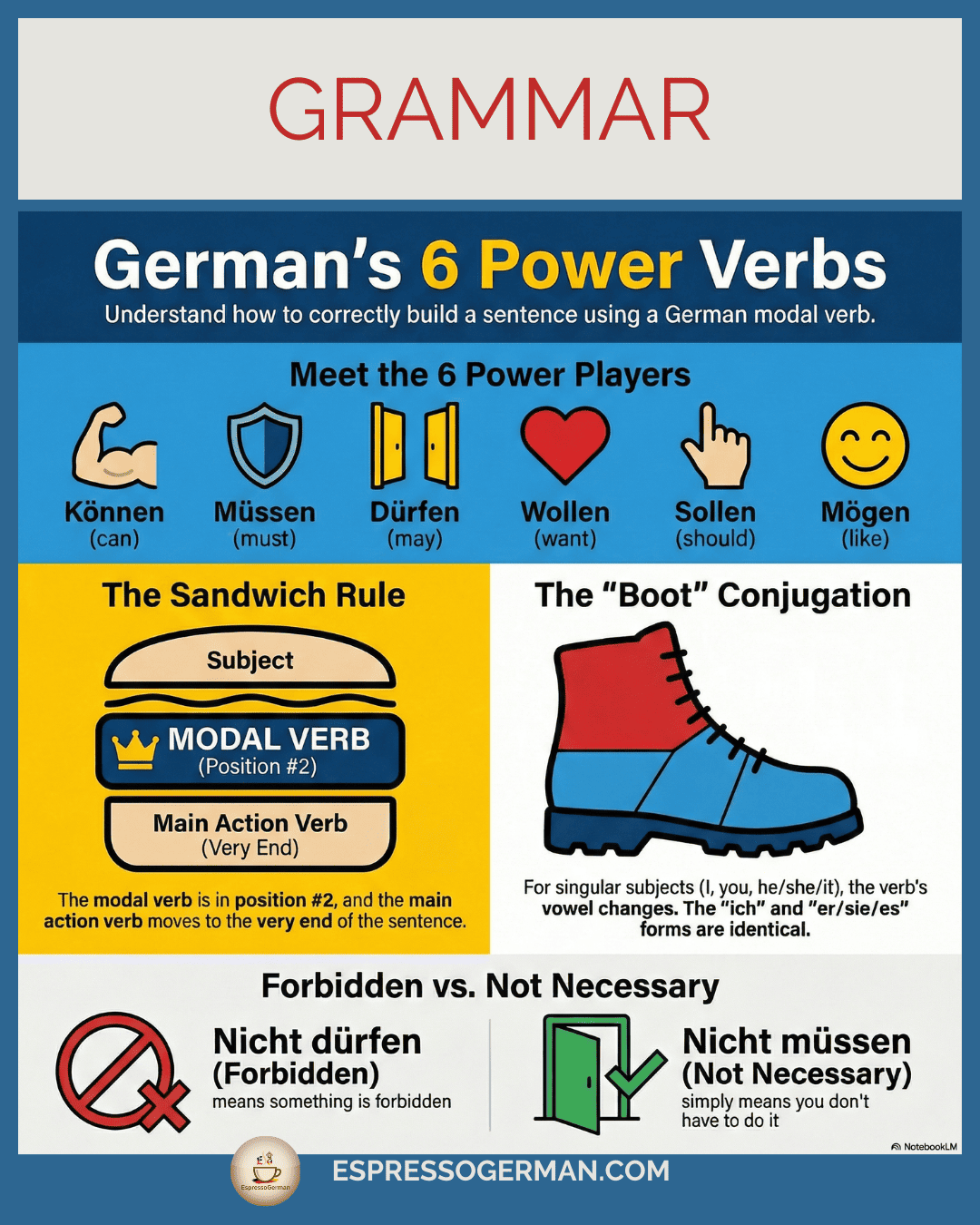
Modal verbs change the "mood" of a sentence.
- Ich esse Pizza. (Fact).
- Ich kann Pizza essen. (Ability).
- Ich muss Pizza essen. (Necessity - maybe I have a pizza debt?).
There are 6 main modal verbs in German. You need them constantly.
The Big Six 6️⃣
| Verb | Meaning | Example |
|---|---|---|
| Können | Can / To be able to | Ich kann schwimmen. |
| Müssen | Must / To have to | Ich muss gehen. |
| Dürfen | May / To be allowed to | Darf ich hier rauchen? |
| Wollen | Want (Strong intent) | Ich will ein Eis. |
| Sollen | Should / Supposed to | Du sollst anrufen. |
| Mögen | Like | Ich mag dich. |
| Möchten | Would like (Polite) | Ich möchte bestellen. |
[!NOTE]
Möchten is technically the subjunctive of Mögen, but used like a 7th modal verb. It's the polite "I want".
The Rules 📏
1. The Sandwich Rule 🥪
The Modal Verb sits in Position 2 (conjugated).
The Main Verb goes to the VERY End (Infinitive).
- Ich kann heute Abend leider nicht ins Kino kommen. (I can ... come).
2. The Boot Conjugation 👢
Modal verbs change their vowel in the singular (Ich, Du, Er/Sie/Es).
Plural forms are regular!
Example: Können (to be able to)
| Person | Conjugation | Change? |
|---|---|---|
| ich | kann | ✅ (ö -> a) |
| du | kannst | ✅ |
| er/sie/es | kann | ✅ |
| wir | können | ❌ Regular |
| ihr | könnt | ❌ Regular |
| sie/Sie | können | ❌ Regular |
[!TIP]
Notice that Ich and Er/Sie/Es are identical! (Ich kann / Er kann). No "-t" ending for He/She/It here!
Nuance Alert: Müssen vs Dürfen 🚦
In English, "must not" means forbidden.
In German, nicht müssen means "don't have to".
FORBIDDEN is nicht dürfen.
- Du musst nicht lernen. (You don't have to study - optional).
- Du darfst nicht rauchen. (You are NOT allowed to smoke - forbidden).
See also...
- Present Tense — Standard conjugation.
- Future Tense — Using Werden (similar structure).