
Perfect Tense (Perfekt) — The Conversational Past 🗣️
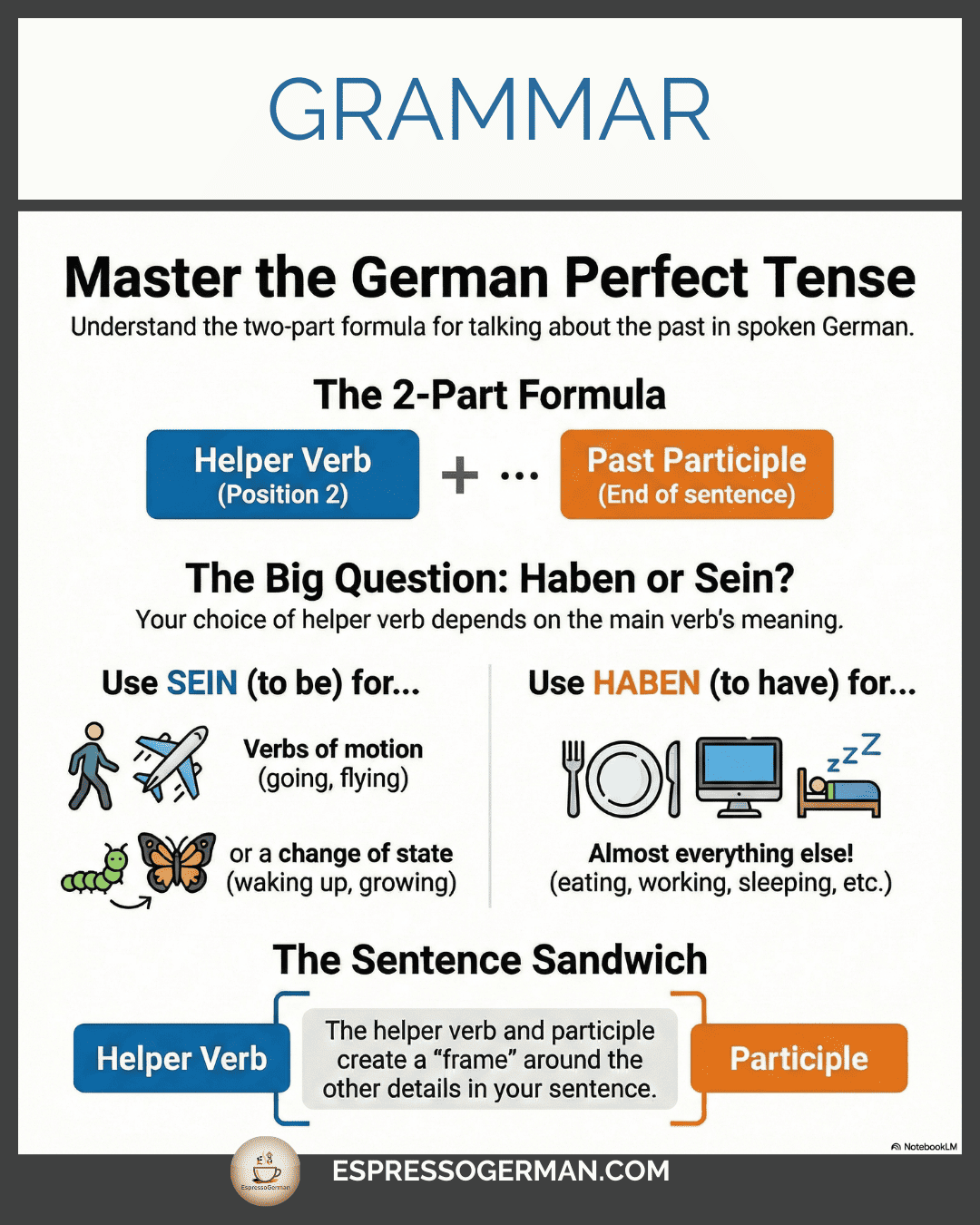
The Perfect tense (Perfekt) is the standard spoken past tense. It forms using a helping verb ('haben' or 'sein') conjugated in position 2, and a Past Participle (often starting with 'ge-') placed at the very end of the sentence.
If you want to speak German, you need the Perfekt.
Spoken German rarely uses the Simple Past (Ich ging). Instead, we say "I have gone" (Ich bin gegangen).
The Formula 🧪
It's a two-part system, just like in English ("I have eaten").
Helper Verb (Position 2) + ... + past Participle (End)
- Ich habe gestern eine Pizza gegessen.
1. The Helper: Haben or Sein? 🤔
Most verbs generally use haben.
But verbs of motion or change of state use sein.
Use "Sein" (to be) for:
- Movement (A to B): gehen, fahren, fliegen, rennen, kommen.
- Ich bin nach Berlin geflogen.
- Change of State: aufwachen (wake up), sterben (die), wachsen (grow).
- Er ist aufgewacht.
- Exceptions: sein (gewesen), bleiben (geblieben).
Use "Haben" (to have) for:
- Everything else! (Eating, sleeping, working, loving).
- Ich habe geschlafen. (Sleeping is not a movement A to B).
2. The Participle (The "Ge-" word) 📦
For regular verbs, the formula is: ge + stem + t.
- machen ➔ ge-mach-t
- lernen ➔ ge-lern-t
For irregular verbs, it's often ge + stem + en (and obscure vowel changes).
- essen ➔ ge-gess-en
- trinken ➔ ge-trunk-en
- gehen ➔ ge-gang-en
[!TIP]
Don't try to guess the irregulars. You just have to learn them. "Ge-run-en"? No, gerannt. "Ge-go-en"? No, gegangen.
The Sandwich Structure 🥪
German loves to bracket sentences.
The Helper and the Participle form a frame around the sentence.
- Ich habe [gestern mit meinem Freund im Park Fußball] gespielt.
- Everything else goes in the middle!
Common Pitfalls ⚠️
- ❌ "I have gone": English uses "have". German uses "be". (Ich habe gegangen is WRONG. Ich bin gegangen).
- ❌ Word Order: Putting usage verbs in the middle. Ich habe gespielt Fußball. (NO!). Ich habe Fußball gespielt. (YES!).
Fun Fact: The "Sein" Logic 🤓
Why do we use "to be" for movement?
Think of it as identifying with the result.
- Ich bin gelaufen. -> "I am [in a state of having] run."
It emphasizes the change in location or condition of the subject.
English used to do this too! "Joy to the world, the Lord is come" (not has come). German just kept it old school.
See also...
- Simple Past (Präteritum) — The written version.
- Past Perfect — The "past before the past".