
Verbs (Verben) — The Action Heroes 🎬🏃
Verbs describe actions or states of being. The raw vocabulary form is the infinitive, which almost always ends in '-en' (spielen, lernen). They are the engine of a German sentence and their positioning defines exactly what the sentence means.
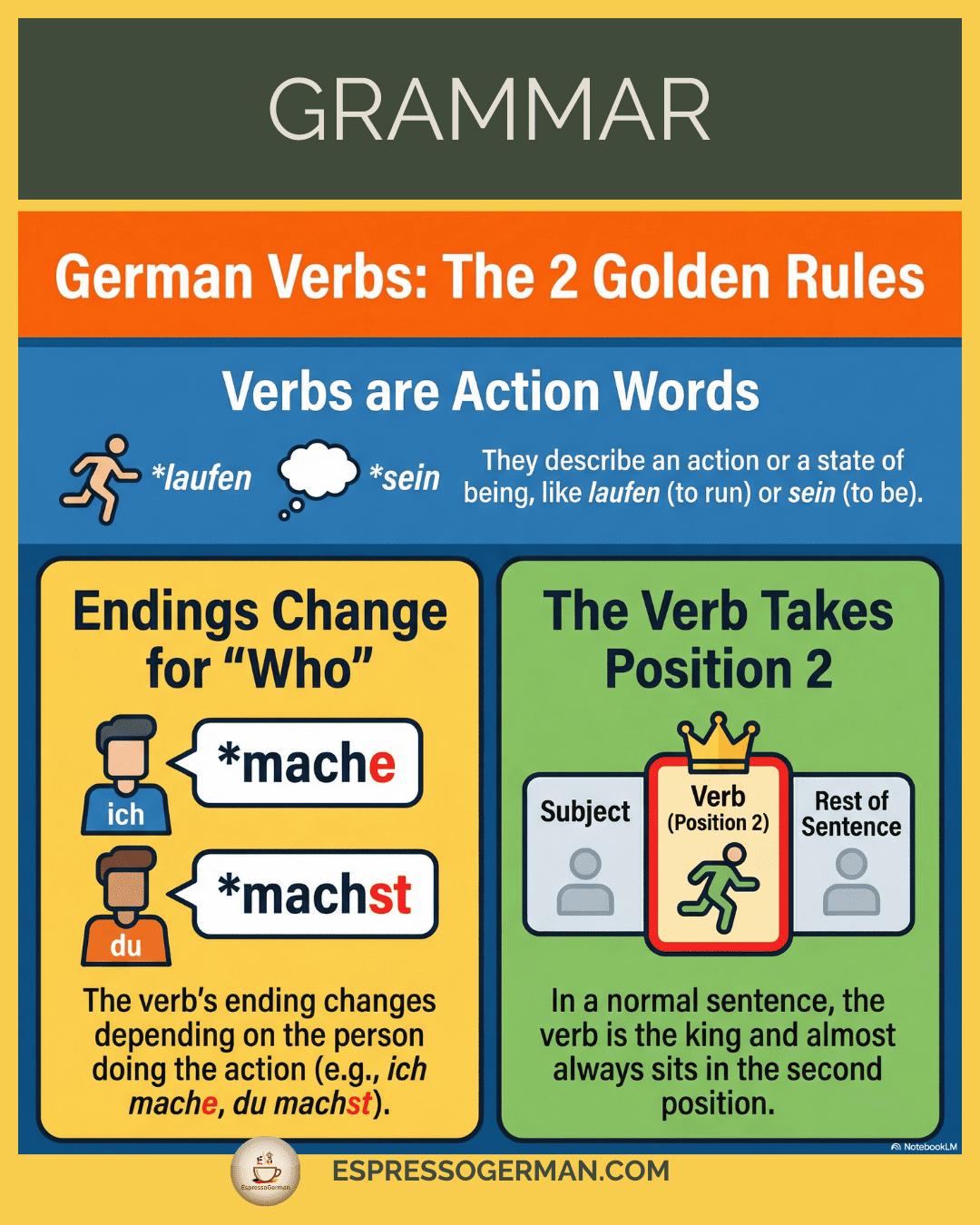
Verbs describe actions (to go) or states (to be).
In German, the verb is the King of the sentence. It dictates the structure.
1. The Infinitive (The Dictionary Form)
Most German verbs end in -en.
- machen (to do)
- gehen (to go)
- schlafen (to sleep)
2. Conjugation (Changing the Costume) 🎭
You must change the ending to match the person (ich, du, er...).
- ich mache
- du machst
- er macht
👉 Deep Dive: See Present Tense for the full chart.
3. Position (The V2 Rule) 🥇
In a normal sentence, the verb MUST be at Position 2.
- Ich esse heute Pizza.
- Heute esse ich Pizza. (Even if you start with "Today!").
👉 Deep Dive: Learn the Word Order (V2).
4. Tenses (Time Travel) ⏳
German has fewer tenses than English.
- Present: Now & Future. (Ich gehe).
- Simple Past: Written stories. (Ich ging).
- Perfect: Spoken past. (Ich bin gegangen).
👉 Deep Dive: Visit the Verbs & Tenses category.
5. Regular vs. Irregular 🚨
Most verbs are Regular (Weak). They follow the rules.
- Ich lerne, du lernst, er lernt.
Some verbs are Irregular (Strong). They change their vowel in the middle.
- Fahren (to drive) -> Du fährst (a -> ä).
- Sehen (to see) -> Du siehst (e -> ie).
- Sprechen (to speak) -> Du sprichst (e -> i).
[!CAUTION]
Sein (To Be) is the rebel.
Ich bin, du bist, er ist, wir sind...
You just have to memorize it.
See also...
- Modal Verbs — The "Can/Must" words.
Ready to practice?
Practice your verb vocabulary!