
Nouns (Nomen) — The Building Blocks 🧱
Nouns are the names of people, places, things, or concepts. In German, there are two unbreakable rules: Every single noun must be capitalized, and every noun belongs to one of three grammatical genders (masculine, feminine, or neuter).
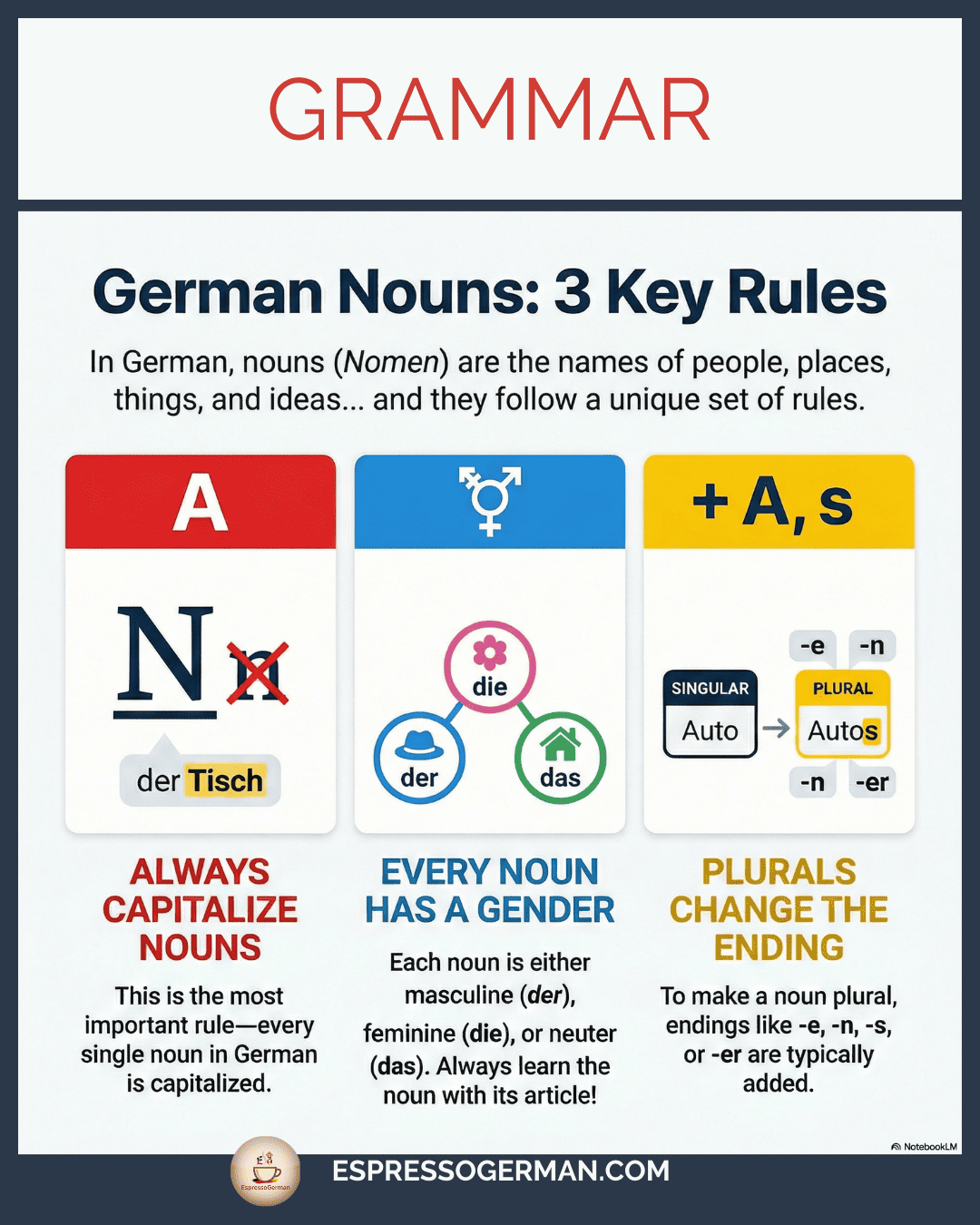
Nouns are things, people, places, and ideas.
In German, they are the VIPs of the sentence.
1. Capitalization (The Big Letter Rule) 🔠
In German, EVERY Noun is Capitalized.
Not just names (Startbucks, Berlin), but ALL nouns.
- *der Hund* (the dog)
- *die Liebe* (the love)
- *das Essen* (the food)
[!TIP]
If you can put "the", "a", or "my" in front of it, Capitalize It!
2. Gender (The Nightmare) ⚧️
Every noun has a gender: Masculine (der), Feminine (die), or Neuter (das).
This is not about biology. It's about grammar.
- Der Löffel (The spoon - Masc)
- Die Gabel (The fork - Fem)
- Das Messer (The knife - Neut)
👉 Deep Dive: Go to Der, Die, Das to master this.
3. Plural (More than one) 👯
English usually adds "-s". German has 5 different ways!
- Autos (-s)
- Fische (-e)
- Kinder (-er)
- Frauen (-en)
- Väter (-)
👉 Deep Dive: Check out Plural Rules.
4. Declension (Changing Forms) 🎭
Nouns change slightly depending on the Case (Nom, Acc, Dat, Gen).
Usually, the noun stays safe, but the Article changes (der -> den).
However, sometimes the noun gets an ending (n-declension or Genitive -s).
- Das Auto des Vaters. (Genitive -s).
- Ich sehe den Jungen. (N-Declension).
5. Compound Nouns (LEGO Words) 🧱
German is famous for long words.
We just glue nouns together.
- Die Donau (Danube) + Dampf (Steam) + Schiff (Ship) + Fahrt (Trip).
- Die Donaudampfschifffahrt.
Rule: The LAST word decides the gender.
- Der Tisch + Das Bein = Das Tischbein (Neut because of Bein).
- Die Hand + Der Schuh = Der Handschuh (Masc because of Schuh).
6. Common Endings (Gender Suffixes)
Some endings guarantee the gender.
- -ung, -heit, -keit, -schaft -> Always Die. (Die Freiheit).
- -chen, -lein -> Always Das. (Das Mädchen).
See also...
- Nouns & Gender Category — All detailed articles.
Ready to practice?
Master Der, Die, Das!