
Grammatical Gender — Der, Die, Das ⚧️🤯
In German, every noun has a grammatical gender: masculine (der), feminine (die), or neuter (das). This gender often doesn't correspond to the physical object's characteristics. Always learn new vocabulary together with its definite article to ensure you use the correct declensions later on.
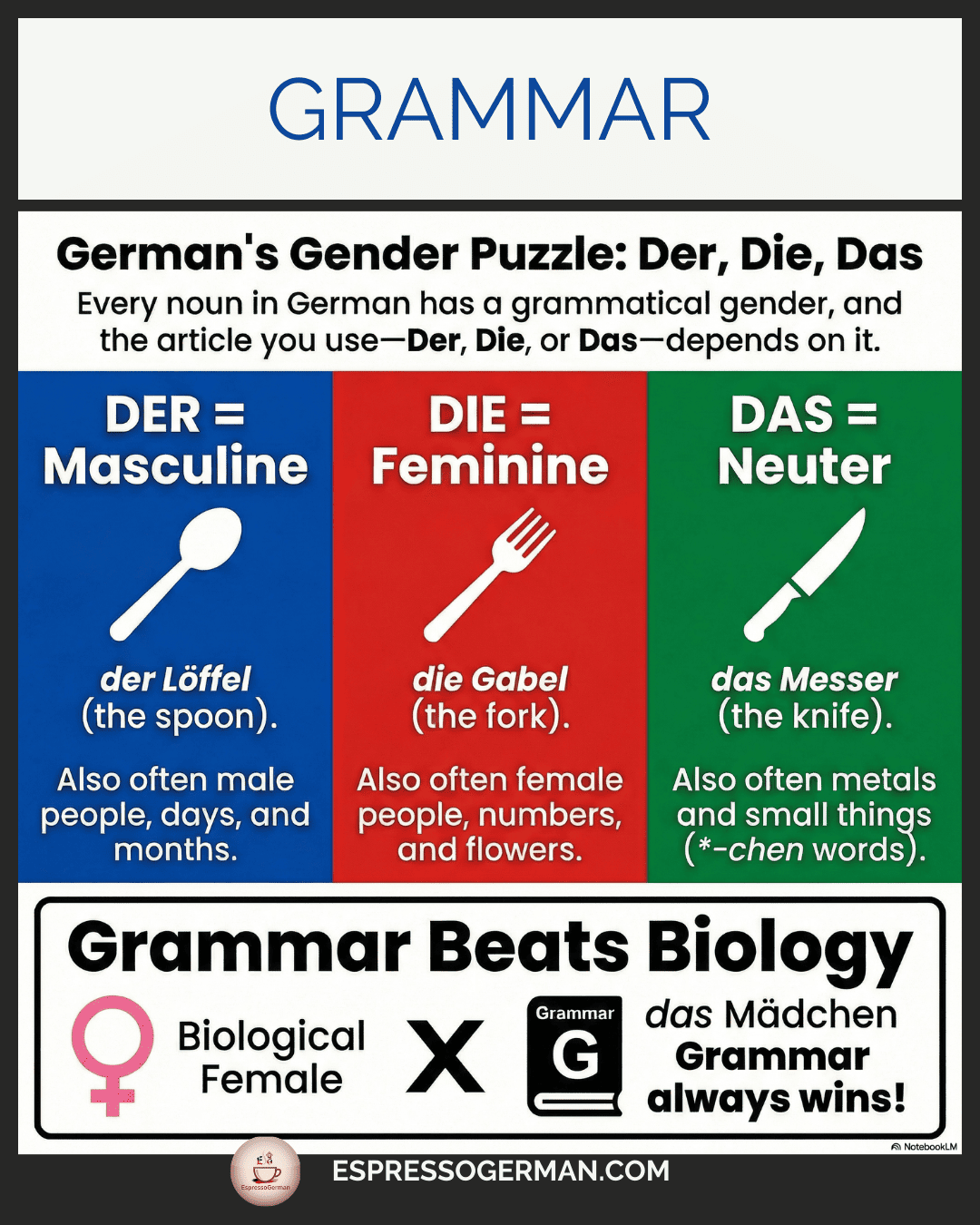
Welcome to the most famous headache in German learning: Gender.
If you have ever asked yourself, "Why on earth is a spoon masculine?!", you are in the right place. Step into the support group. We have cookies (which are die Kekse, by the way). 🍪
The Hard Truth 🛑
In English, gender is easy.
- He = Man
- She = Woman
- It = Everything else (Table, Car, Idea)
In German, everything has a gender.
- der Löffel (the spoon) — Masculine ♂️
- die Gabel (the fork) — Feminine ♀️
- das Messer (the knife) — Neuter ⚪
Why? Just... Why?
There is no logical reason why a spoon is masculine. It's not biology. It's not about looking "manly." It is simply Grammar.
The gender belongs to the word, not the object.
[!IMPORTANT]
Biological vs. Grammatical Gender
Usually, they match for people: Der Mann is masculine, Die Frau is feminine.
But look at Das Mädchen (the girl). Biologically female, but grammatically Neuter. Why? because of the ending -chen. In German grammar, suffixes (endings) are more powerful than biology!
The Three Articles 🚦
1. Der (Masculine) 🔵
Used for ~34% of nouns.
- Der Mann (The man)
- Der Tisch (The table)
- Der Morgen (The morning)
2. Die (Feminine) 🔴
Used for ~46% of nouns. (Yes, it's the most common one! When in doubt, maybe guess die?)
- Die Frau (The woman)
- Die Sonne (The sun)
- Die Liebe (The love)
3. Das (Neuter) 🟢
Used for ~20% of nouns.
- Das Auto (The car)
- Das Buch (The book)
- Das Leben (The life)
Learning Strategy: Color Coding 🎨
Since you need to memorize the gender with every single noun you learn, your brain needs a hook.
Most learners use colors.
- Blue = Masculine (Der)
- Red = Feminine (Die)
- Green = Neuter (Das)
When you write vocabulary flashcards, write Tisch in Blue ink. Write Sonne in Red ink. Visual memory is powerful!
What happens if I get it wrong? 🤷♂️
If you order "Das Bier" (correct) or "Die Bier" (wrong), the waiter will still bring you a beer.
Germans will understand you 99% of the time. However, using the wrong gender sounds like saying "The me coffee give" in English. It's understandable, but definitely sounds like a caveman.
To reach a high level (B2/C1), you absolutely need to master this.
See also...
- Gender Markers — The secret tricks to guess the gender correctly 80% of the time!
Ready to practice?
Master Der, Die, Das with our interactive quiz!