
Plural Formations — More is Better 👯♂️
Unlike English with its simple '-s', German has five distinct plural endings: -e, -er, -n/-en, -s, or no ending at all. Many plurals also add an umlaut (¨) to the main vowel. Always memorize the plural form alongside the singular vocabulary word.
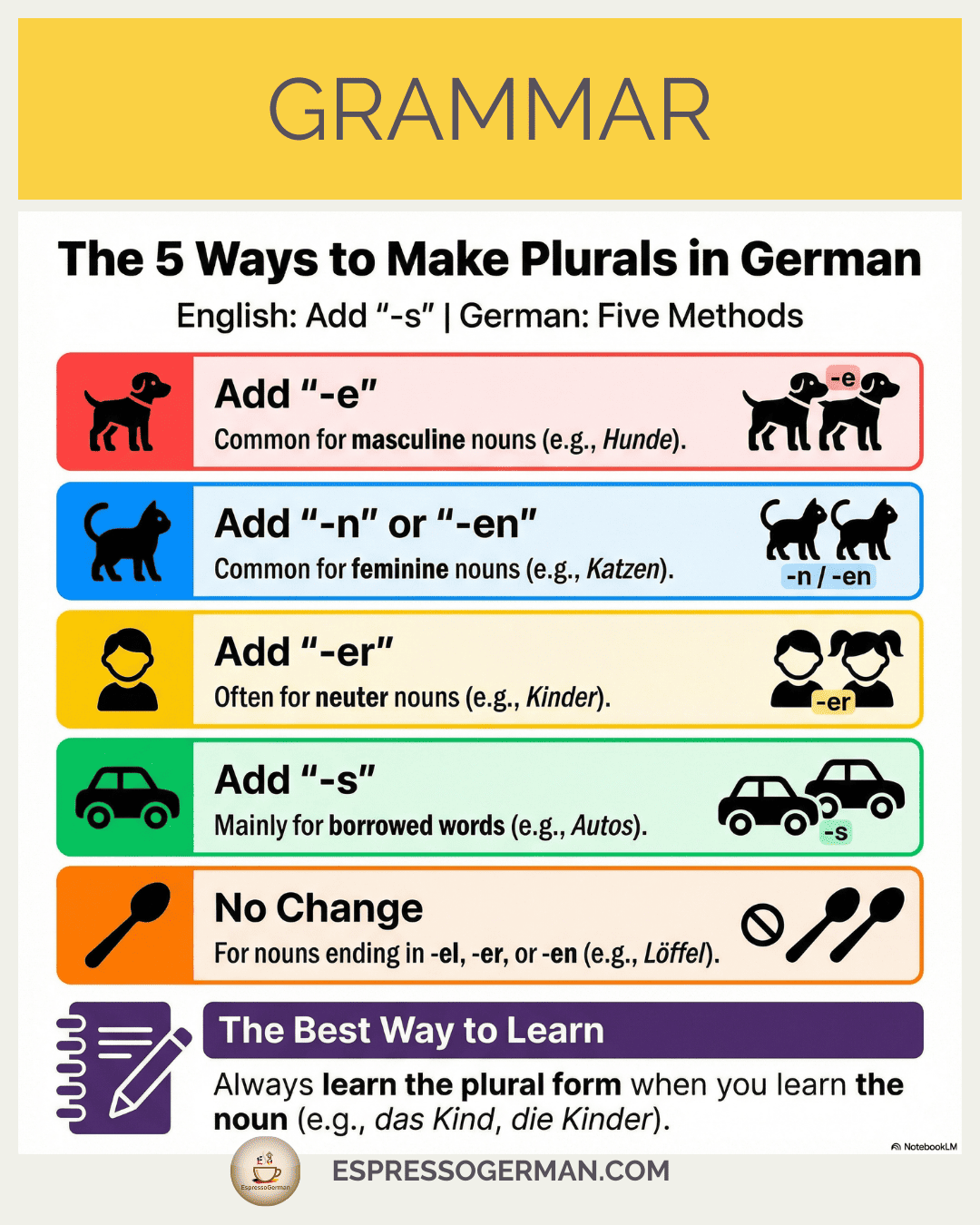
In English, you usually just add "s".
- Cat ➔ Cats. Simple.
In German, we have five different ways to make a plural. Because why make it easy?
1. The "-e" Plural (Common for Masculine) 🟦
Many masculine words (and some neuter) take an -e.
Often, they also add an Umlaut.
- der Tag ➔ die Tage
- der Hund ➔ die Hunde
- der Stuhl ➔ die Stühle (Umlaut added!)
- die Hand ➔ die Hände (Fem. Exception)
2. The "-n" or "-en" Plural (The Feminine Favorite) 🟥
Most feminine words end in -n or -en. This is the most consistent rule!
If it ends in -e, just add -n. If not, add -en.
- die Katze ➔ die Katzen
- die Frau ➔ die Frauen
- die Zeitung ➔ die Zeitungen
[!TIP]
If a noun ends in -ung, -heit, -keit, -schaft, -ion, the plural is ALWAYS -(e)n.
3. The "-er" Plural (Neuter Power) 🟩
Many short neuter words take -er (and almost always add an Umlaut if possible).
- das Kind ➔ die Kinder
- das Bild ➔ die Bilder
- das Haus ➔ die Häuser (Umlaut!)
- der Mann ➔ die Männer (Masc. Exception)
4. The "-s" Plural (International Words) 🌍
Words borrowed from English or French often keep the -s.
- das Auto ➔ die Autos
- das Handy ➔ die Handys
- das Team ➔ die Teams
5. No Change (The Lazy Plural) 😴
Words ending in -el, -er, -en usually don't change at all (or just add an Umlaut).
- der Löffel ➔ die Löffel
- der Lehrer ➔ die Lehrer
- der Vater ➔ die Väter (Umlaut only)
- das Mädchen ➔ die Mädchen
Summary Cheatsheet
| Ending | Gender Tendency | Example |
|---|---|---|
| -(e)n | Feminine (90%) | Frau -> Frauen |
| -e | Masculine | Tag -> Tage |
| -er | Neuter | Kind -> Kinder |
| -s | Foreign | Auto -> Autos |
| - | -el/-er/-en words | Lehrer -> Lehrer |
See also...
- Grammatical Gender — Review gender rules.
Ready to practice?
Practice your case endings now!