
The German Tense System — Less is More ⏳
German has six official tenses, but in daily conversation, you primarily need just two: the Present tense (Präsens) for currently happening or future events, and the Perfect tense (Perfekt) for anything that happened in the past.
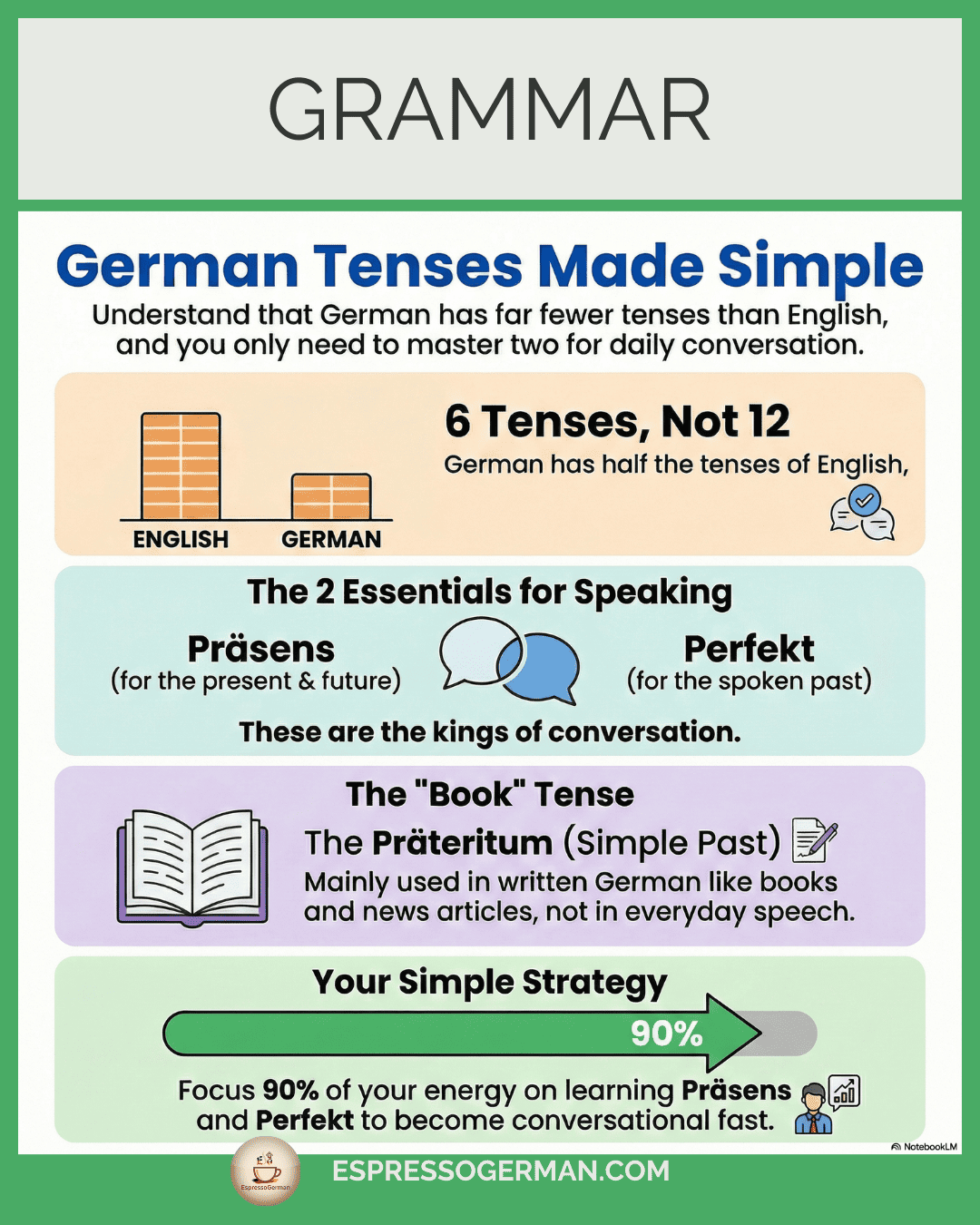
Good news! The German tense system is much simpler than English.
English has 12 (!) tenses. Only 6 exist in German. And honestly? You only really need 2 or 3 for daily life.
The Big Picture 🗺️
| Tense | German Name | Usage | Frequency |
|---|---|---|---|
| Present | Präsens | Now & Future | ⭐⭐⭐⭐⭐ (Essential) |
| Perfect | Perfekt | Spoken Past | ⭐⭐⭐⭐⭐ (Essential) |
| Simple Past | Präteritum | Written Past | ⭐⭐⭐ (Bookish) |
| Pluperfect | Plusquamperfekt | "Had done" | ⭐⭐ (Rare) |
| Future I | Futur I | Assumption / Future | ⭐⭐ (Rare) |
| Future II | Futur II | "Will have done" | ⭐ (Unicorn 🦄) |
1. The "Now" (Präsens)
German is efficient. We use the Present tense for right now AND for the future.
- Ich lerne Deutsch. (I am learning German).
- Morgen gehe ich ins Kino. (Tomorrow I [will] go to the cinema).
No need for "I am going to..." constructions!
2. The "Past" (Perfekt vs. Präteritum)
This is where English speakers get confused.
In English, "I went" and "I have gone" have different meanings.
In German, the difference is mostly Format, not meaning.
- Spoken German: Use Perfekt (Ich habe gegessen).
- Written German (Books, News): Use Präteritum (Ich aß).
[!TIP]
Focus 90% of your energy on the Perfekt. It is the king of conversation.
3. The "Future" (Futur I)
Wait, didn't I say we use Present for Future? Yes.
So why does Futur I exist?
Mostly for Assumptions or dramatic predictions.
- Er wird schon schlafen. (He is probably sleeping already).
- Wir werden sehen. (We will see).
Summary Strategy 🧠
- Master Präsens (Present).
- Master Perfekt (Spoken Past).
- Recognize Präteritum (Written Past) so you can read books, but don't stress about speaking it (except for sein and haben).
- Ignore the rest until you are B1/B2 level.
German vs. English: The Showdown 🥊
| English | German | Notes |
|---|---|---|
| I go | Ich gehe | Simple Present. |
| I am going | Ich gehe | German has no "-ing"! Just use Present. |
| I will go | Ich gehe (morgen) | We barely use Future tense. |
| I went | Ich bin gegangen | We prefer Perfect (Helper+Ge) for speaking. |
| I have gone | Ich bin gegangen | Same structure. |
| I had gone | Ich war gegangen | Same structure. |
Key Takeaway: German merges many English nuances into one form. "I play", "I am playing", "I do play" are ALL just Ich spiele. Context does the rest!
See also...
- Present Tense — Start here.
- Perfect Tense — The spoken past.