
Present Tense — The Backbone 🦕
The Present tense is formed by removing the '-en' or '-n' ending from the infinitive verb to find the stem, then attaching subject-specific endings: -e, -st, -t, -en, -t, -en. It is heavily used to describe both ongoing actions and scheduled future events.
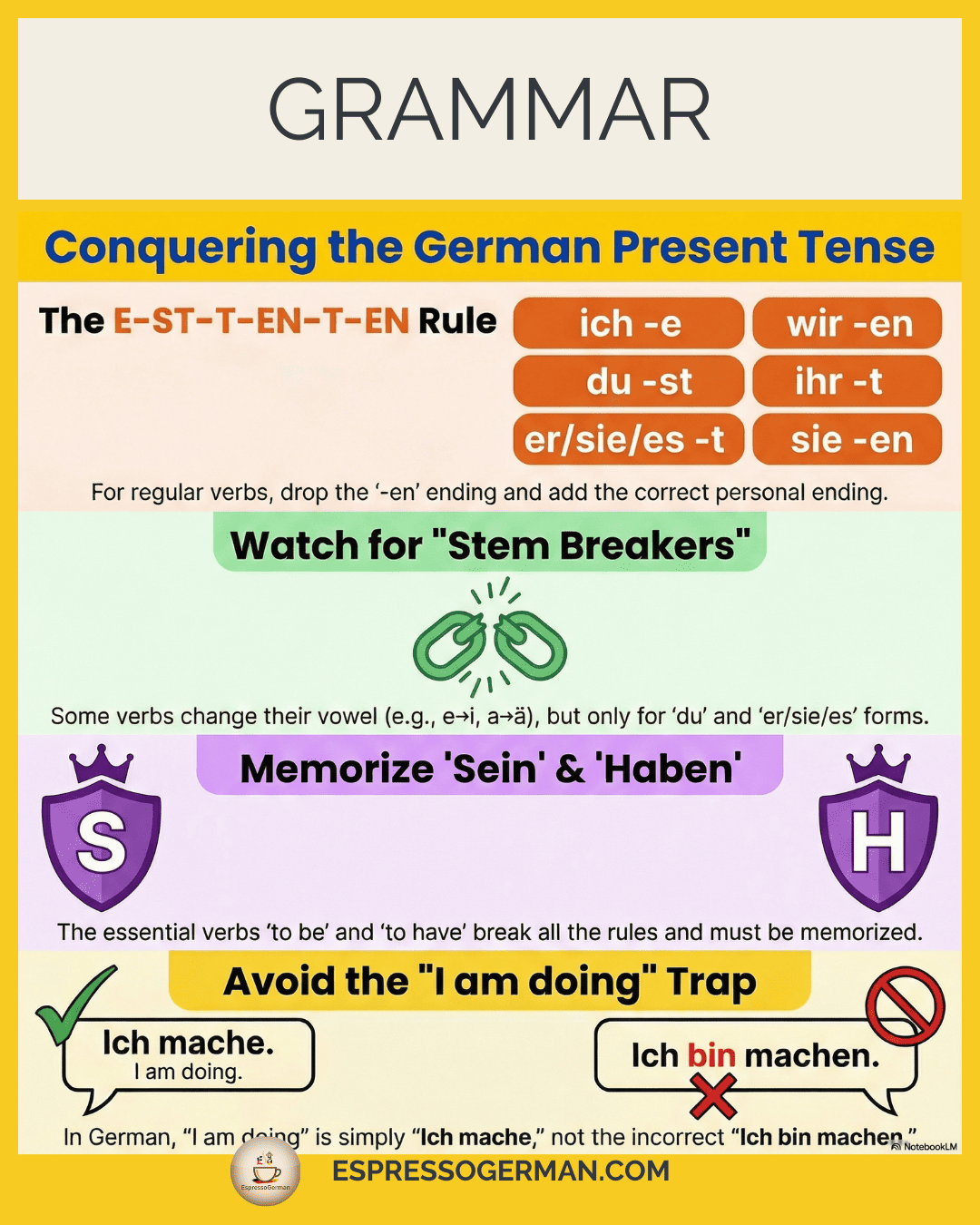
The Präsens (Present Tense) is the workhorse of German.
You use it for:
- Facts (Ich heiße Jan).
- Current actions (Ich esse eine Pizza).
- The Future (Morgen fliege ich nach Berlin).
The Endings (E-ST-T-EN-T-EN) 🧩
To conjugate a regular verb (like machen - to make/do), you remove the -en and add the ending for the person.
| Person | Ending | Example (machen) | Translation |
|---|---|---|---|
| ich | -e | ich mache | I do |
| du | -st | du machst | You do |
| er/sie/es | -t | er macht | He/she/it does |
| wir | -en | wir machen | We do |
| ihr | -t | ihr macht | You (plural) do |
| sie/Sie | -en | sie machen | They/You (formal) do |
[!TIP]
Mnemonic: "E-S-T-T-E-N" (Estten? EST-Ten? Okay, maybe just memorize it).
Note that Wir and sie (plural) are always the same as the Infinitive!
Irregular Verbs (Stem Breakers) 💔
Some strong verbs change their vowel in the middle, but ONLY for Du and Er/Sie/Es.
The endings stay the same!
Type 1: e ➔ ie / i
- Sehen (to see):
- Ich sehe
- Du siehst
- Er sieht
- Geben (to give):
- Du gibst, Er gibt.
Type 2: a ➔ ä
- Fahren (to drive):
- Ich fahre
- Du fährst
- Er fährt
- Schlafen (to sleep):
- Du schläfst.
The Super-Irregulars: Sein & Haben
These break all rules. Memorize them immediately.
| Person | Sein (to be) | Haben (to have) |
|---|---|---|
| ich | bin | habe |
| du | bist | hast |
| er/sie/es | ist | hat |
| wir | sind | haben |
| ihr | seid | habt |
| sie/Sie | sind | haben |
Common Pitfalls ⚠️
- ❌ "I am doing": English speakers often try to translate "I am doing" word by word (Ich bin machen). WRONG!
- Using "am" (bin) implies being something. "I am making" = Ich mache. Simple!
- ❌ Forgetting the Umlaut: Du fahrst (No!) -> Du fährst.
See also...
- Modal Verbs — Can, Must, Want.
- Perfect Tense — Talking about the past.