
Nominative Case — The Subject 👑
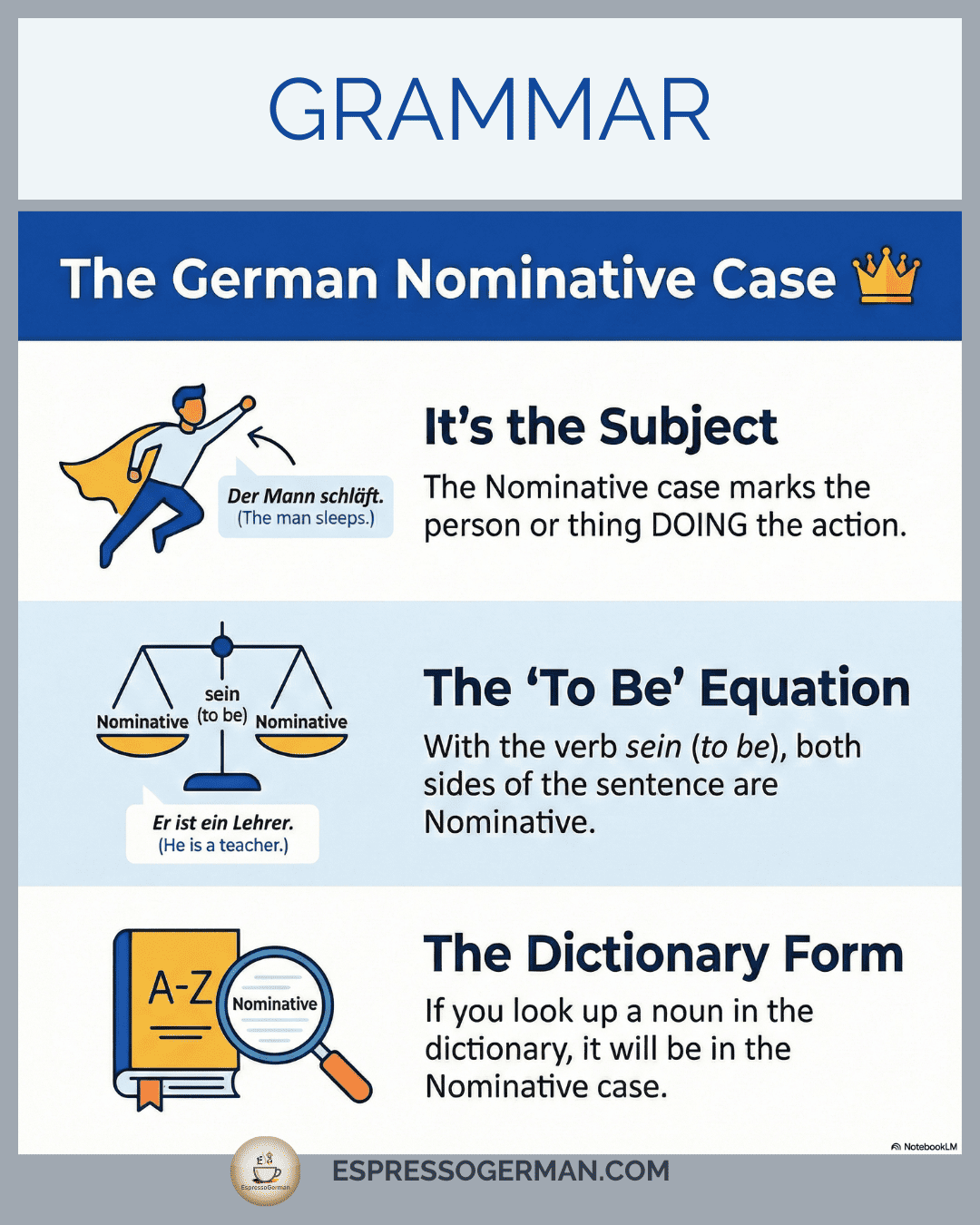
The Nominative case is the base form of a noun and represents the subject of the sentence—the person or thing performing the action. It is the form you find in dictionaries: der Mann, die Frau, das Kind. Use it after the verb 'sein' (to be).
German has four cases: Nominative, Accusative, Dative, and Genitive.
Today we start with the easiest one: The Nominative.
What is it? 🤷♂️
The Nominative is the Subject of the sentence. It is the person or thing that is doing the action.
It is also the "default" state of a noun. If you look up a word in the dictionary, it is in Nominative.
- Der Mann schläft. (The man sleeps).
- Die Frau lacht. (The woman laughs).
- Das Kind spielt. (The child plays).
Here, the man, the woman, and the child are the stars. They are the subjects.
The Articles in Nominative 📋
This is your baseline table.
| Gender | Definite (The) | Indefinite (A/An) |
|---|---|---|
| Masculine | der Mann | ein Mann |
| Feminine | die Frau | eine Frau |
| Neuter | das Kind | ein Kind |
| Plural | die Kinder | - Kinder |
The Special Case: "Sein" (To Be) 🪞
The verb sein (to be) acts like an equals sign (=).
In specific grammar terms, it doesn't have an "Object." It just links two things together.
Therefore, BOTH SIDES of the sentence are in Nominative.
- Er ist ein guter Freund. (He = A good friend).
- Das ist der Tisch. (That = The table).
[!WARNING]
Many beginners think: "I am seeing him" -> Ich sehe ihn (Accusative). So "It is him" -> Es ist ihn? NO!
"It is he" (technically correct in old English too!).
- Das ist er. (Nominative).
Personal Pronouns (Nominative)
You know these already.
- ich, du, er, sie, es, wir, ihr, sie
When do I NOT use it?
As soon as something is being acted upon.
- Der Mann isst den Apfel.
- The man is Nominative (Subject).
- The apple is NOT doing anything. It is being eaten. So it changes to Accusative.
Fun Fact 🤓
In English, we actually still have Case markers too!
Look at pronouns:
- I see him. (Subject / Nominative).
- He sees me. (Object / Accusative).
You would never say "Me sees he." That sounds crazy.
German just applies this logic to nouns too (Der Mann vs Den Mann), not just pronouns.
See also...
- Accusative Case — The Direct Object (when things get interesting).
- Grammatical Gender — Review Der, Die, Das.
Ready to practice?
Practice your case endings now!