
Prepositions (Präpositionen) — The Case Controllers 🕹️
Prepositions link nouns or pronouns to other words, establishing relationships of time, place, or logic (in, an, für, mit). In German, each preposition acts as a strict boss, demanding that the following noun takes either the Accusative, Dative, or Genitive case.
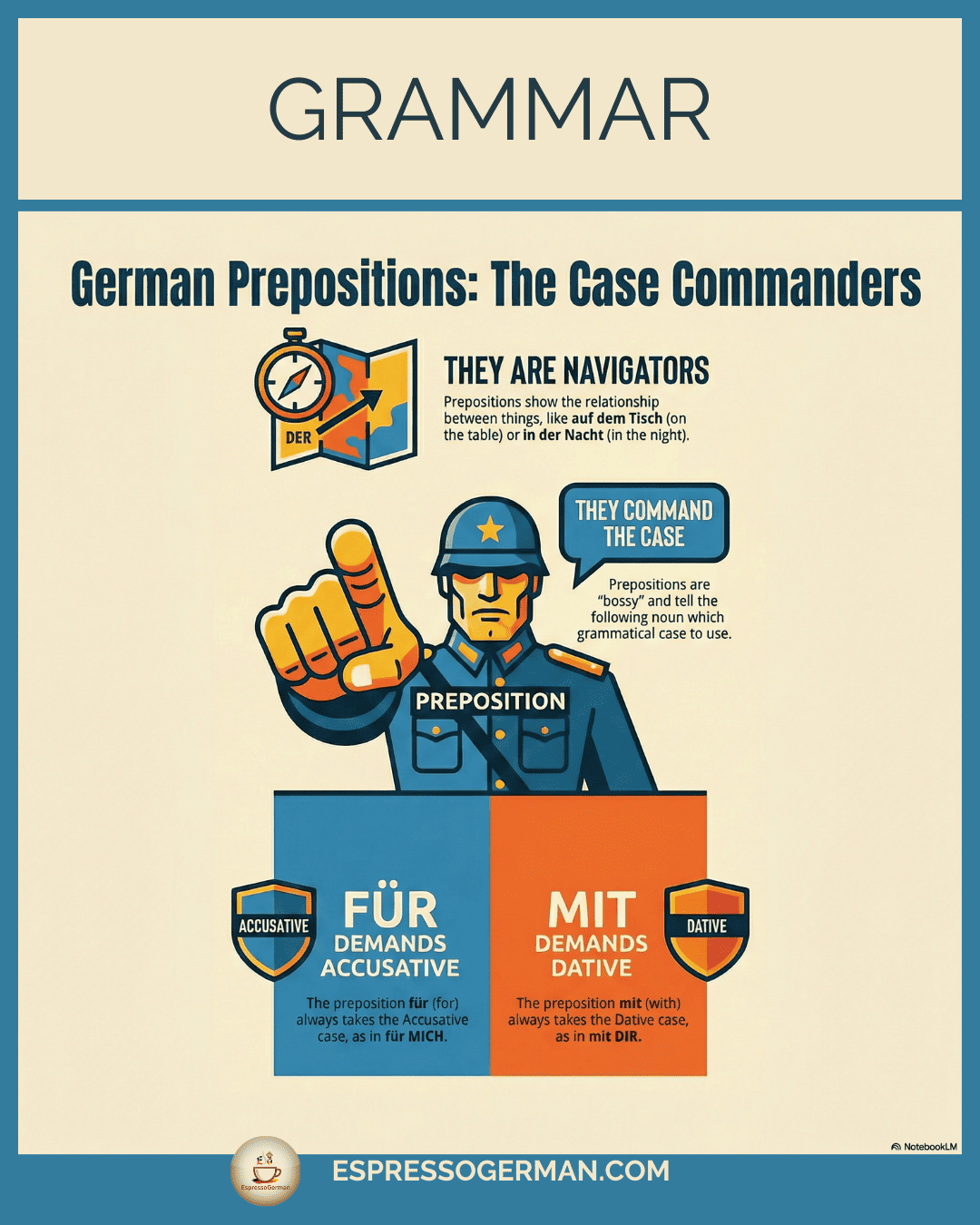
Prepositions are small words like in, at, on, for, with.
They connect nouns to the rest of the sentence.
In German, they are powerful dictators: They decide the Case of the next word.
1. Accusative Prepositions (The FUDGE) 🍫
These ALWAYS require the Accusative.
- Für, Um, Durch, Gegen, Entlang.
- Für mich. (Not mir).
2. Dative Prepositions (The Blue Danube) 🌊
These ALWAYS require the Dative.
- Aus, Bei, Mit, Nach, Seit, Von, Zu.
- Mit dir. (Not dich).
3. Two-Way Prepositions (The Switchers) 🔛
These can be Accusative OR Dative, depending on "Movement vs. Position".
- In, An, Auf, Neben...
- Ich gehe in den Park. (Movement -> Acc).
- Ich bin im Park. (Position -> Dat).
4. Genitive Prepositions (The Fancy Ones) 🎩
- Wegen, Trotz, Während...
- Wegen des Wetter*s.*
👉 Deep Dive: Go to the Prepositions Category to learn them all.
5. The "Pronominal Adverbs" (Da- & Wo-) 🏗️
Germans hate saying "Preposition + It".
Instead of "with it" (mit es), we say "damit" (there-with).
Instead of "for what?" (für was?), we say "wofür?" (where-for).
- Ich warte darauf. (I wait for it).
- Ich habe Angst davor. (I have fear of it).
👉 Deep Dive: Learn this magic trick at Pronominal Adverbs.
See also...
- Accusative — The FUDGE list.
- Dative — The Blue Danube list.
Ready to practice?
Train your preposition usage!