
Relative Pronouns — The Connectors 🔗
Relative pronouns link a noun to a subordinate clause that provides more information about it ('The man, WHO is here'). In German, they look identical to definite articles (der, die, das) except in the Dative plural (denen) and Genitive forms (dessen, deren).
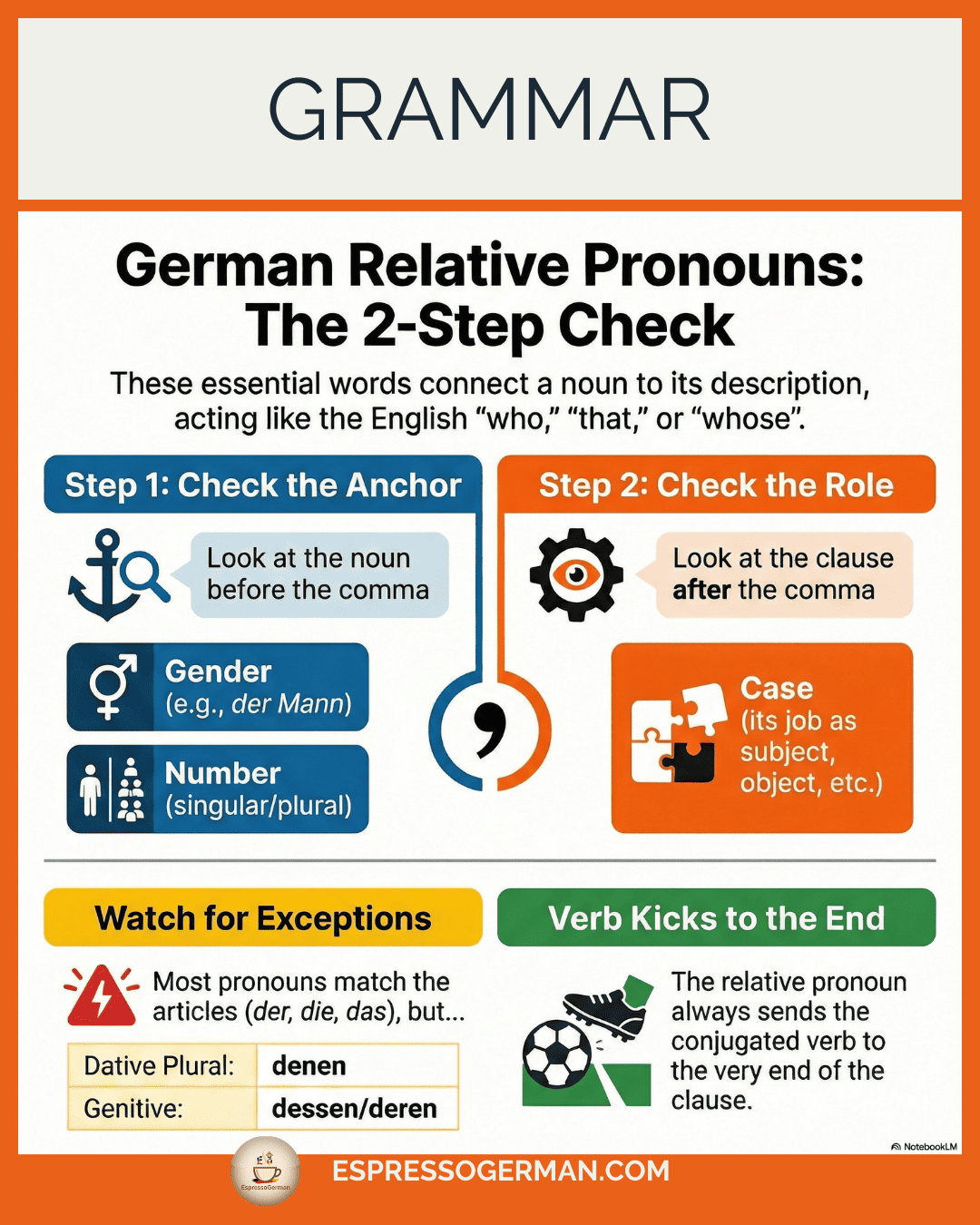
These pronouns are the glue between a noun and a description.
- "The man, who is sleeping."
- "The car, that I bought."
- "The woman, whose cat is ugly."
The "Checklist" Strategy ✅
To find the right pronoun, you need to check two things:
- Gender/Number: Look at the noun BEFORE the comma (The Anchor).
- Case: Look at the verb AFTER the comma (The Role only in the sub-clause).
Example 1
Der Mann, ... ich sehe. (The man that I see).
- Gender: Der Mann is Masculine.
- Case: Ich sehe ihn. The man is the Object (Accusative).
- Masc + Acc = den.
Der Mann, den ich sehe.
Example 2
Die Frau, ... dort steht. (The woman who stands there).
- Gender: Die Frau is Feminine.
- Case: Sie steht. She is the Subject (Nominative).
- Fem + Nom = die.
Die Frau, die dort steht.
The Table 📉
It looks almost exactly like the Definite Articles (der, die, das).
Exceptions: Genitive and Dative Plural.
| Case | Masc | Fem | Neut | Plural |
|---|---|---|---|---|
| Nom | der | die | das | die |
| Acc | den | die | das | die |
| Dat | dem | der | dem | denen 🚨 |
| Gen | dessen | deren | dessen | deren |
[!TIP]
Denen & Dessen:
- Das sind die Kinder, mit denen ich spiele. (Plural Dative).
- Der Mann, dessen Auto rot ist. (The man, whose car is red).
Common Mistakes ⚠️
- Using "Was/Wer?": English speakers often want to use Wer (Who).
- Der Mann, wer ist hier. (WRONG!).
- Der Mann, der hier ist. (Correct).
- Wer is only for questions (Wer ist das?) or indefinite things (Wer das liest, ist doof).
- Wrong Verb Position: The Relative Pronoun kicks the verb to the END.
- Der Mann, der ist nett. (Colloquial/Structural error).
- Der Mann, der nett ist. (Correct).
Prepositions? Keep 'em! 🤝
If the verb uses a preposition, the Relative Pronoun swallows it.
- Der Tisch, auf dem das Buch liegt. (The table, on which the book lies).
- Die Frau, mit der ich spreche. (The woman, with whom I speak).
See also...
- Demonstrative Pronouns — Similar words, different use.
- Conjunctions (Nebensätze) — This kicks the verb to the end!