
Demonstrative Pronouns — Pointing Fingers ☝️👇
Demonstrative pronouns are used to point to specific objects or people for emphasis ('this one', 'that one'). The most common are forms of 'dieser' (this) and using the definite articles (der, die, das) with strong vocal emphasis in spoken German.
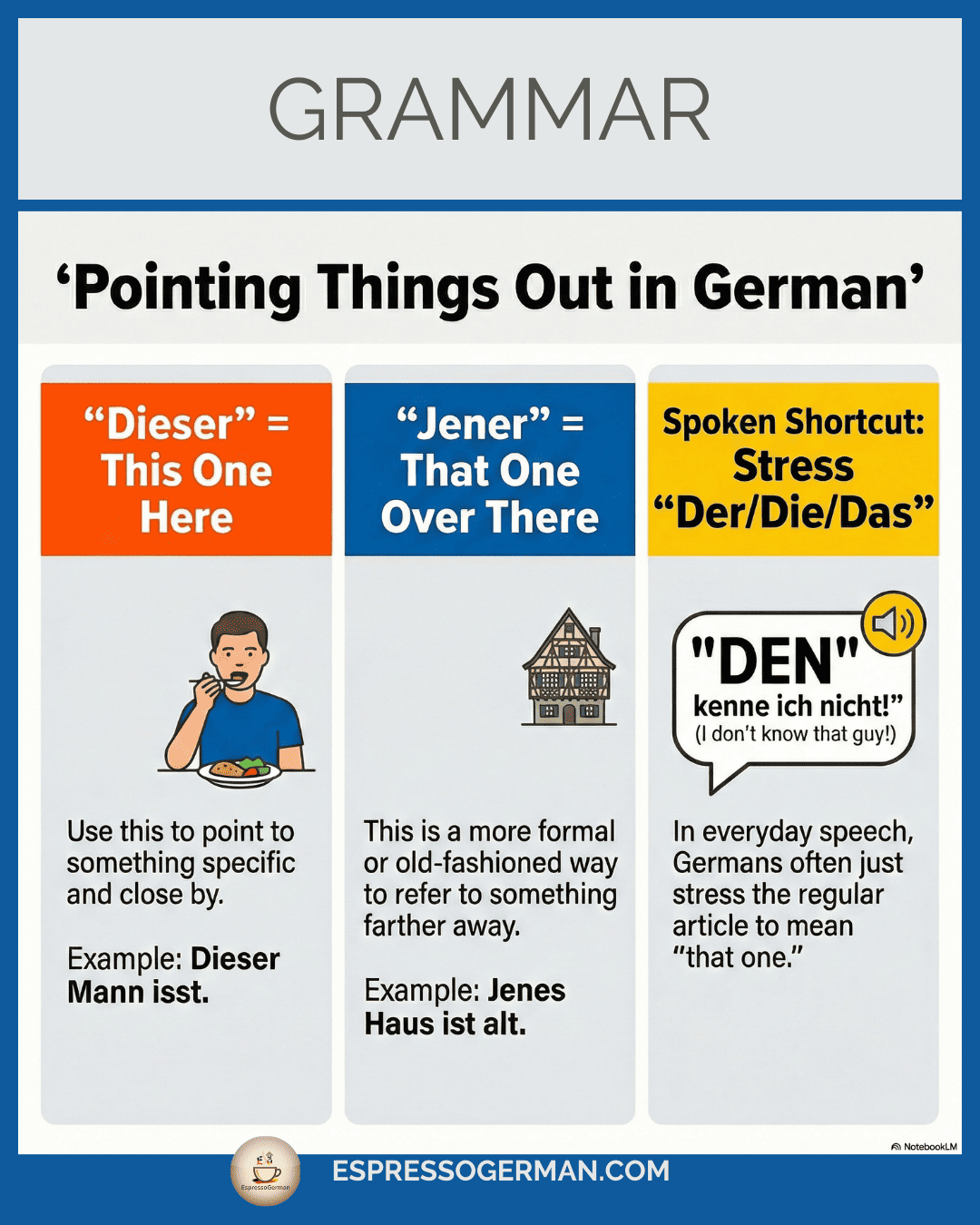
Demonstrative pronouns are used to point at specific things.
"I don't want that car, I want this one."
1. Der, Die, Das (The Finger) 🖕
Wait, aren't these articles?
Yes, but they can duplicate as pronouns!
- Ich mag den Kuchen. (Standard Article).
- Ich mag den da. (Demonstrative Pronoun: "I like that one there").
When spoken, you stress the word heavily.
- "Kennst du den Mann?"
- "Nein, den kenne ich nicht." (No, HIM I don't know).
2. Dieser / Jener (This / That)
Dieser = This (close to speaker).
Jener = That (far from speaker).
Ich möchte diesen Apfel. (This apple here).
Ich möchte jenen Apfel. (That apple over there).
[!NOTE]
Is "Jener" dead? 💀
Almost. In spoken German, nobody says "Jener".
Instead, we say:
- Dieser da (This one there).
- Der da (That one there).
You mostly see jener in formal writing or literature.
3. Derselbe / Dergleiche (The Same) 👯
The Germans have a very specific distinction here.
Derselbe (The self-same): The EXACT same object.
Dergleiche (The like-same): An identical copy.
Wir fahren das gleiche Auto. (We both drive a VW Golf. Two variants of the same model).
Wir fahren dasselbe Auto. (We share ONE car. I drive it on Mondays, you drive it on Tuesdays).
Declension Table (Dieser)
It follows the exact same endings as the Definite Article (der/die/das).
| Gender | Nom | Acc | Dat |
|---|---|---|---|
| Masc | Dieser | Diesen | Diesem |
| Fem | Diese | Diese | Dieser |
| Neut | Dieses | Dieses | Diesem |
| Plural | Diese | Diese | Diesen |
Pronouns vs. Articles 🧐
Wait, if der is an article AND a pronoun, how do I know the difference?
Position!
- Article: Comes BEFORE a noun.
- Ich sehe den Hund. (Accompanies 'Hund').
- Pronoun: STANDS ALONE.
- Ich sehe den. (Stands for 'Hund').
If it's alone, it's a pronoun. If it has a buddy, it's an article.
See also...
- Relative Pronouns — Wait, don't confuse "Der" with "Der"!
- Indefinite Pronouns — The opposite (vague things).