
Personal Pronouns — The Cast of Characters 🎭
Personal pronouns replace specific nouns (I, you, he, she, it). In German (ich, du, er, sie, es), they decline heavily based on the case. For example, 'ich' (Nominative) becomes 'mich' (Accusative) and 'mir' (Dative). Pay special attention to formal 'Sie'.
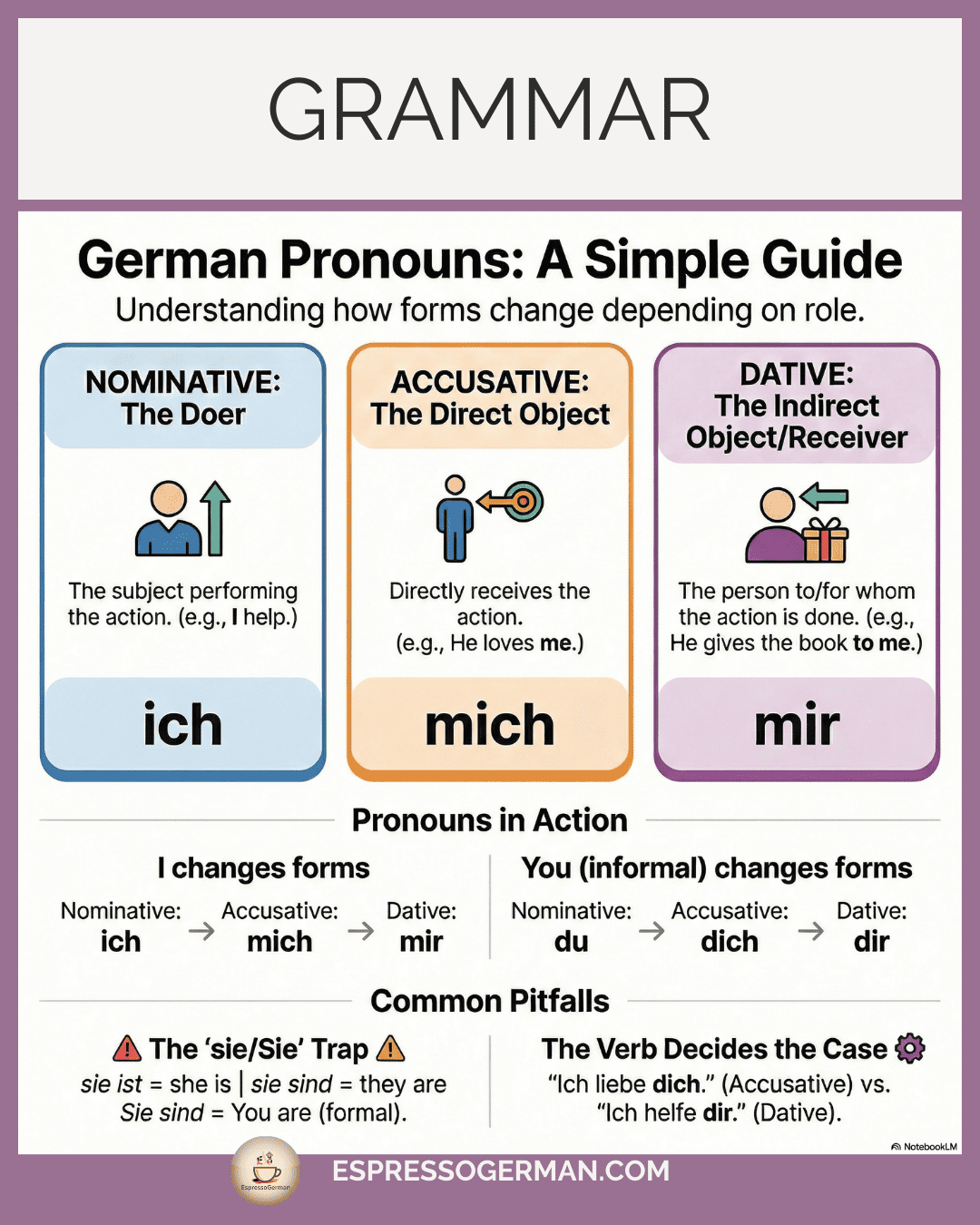
These are the most used words in the entire language.
If you know these tables, you can survive most situations.
The Nominative (The Subject) 👑
Who is doing the action?
| Person | German | English |
|---|---|---|
| 1st Sing | ich | I |
| 2nd Sing | du | You (friend) |
| 3rd Sing | er / sie / es | He / She / It |
| 1st Pl | wir | We |
| 2nd Pl | ihr | You guys (friends) |
| 3rd Pl | sie | They |
| Formal | Sie | You (Boss) |
[!WARNING]
The Triple "Sie" Trap 🤯
- sie (lowercase) = She (Sie ist nett — verb is singular).
- sie (lowercase) = They (Sie sind nett — verb is plural).
- Sie (Capitalized) = You (Formal) (Sie sind nett — verb is plural).
Context is everything!
The Accusative (The Object) 🎯
Used for Direct Objects (für, um, durch...).
| Nom | Accusative | Change? |
|---|---|---|
| ich | mich | (me) |
| du | dich | (you) |
| er | ihn | (him) 🚨 |
| sie | sie | - |
| es | es | - |
| wir | uns | (us) |
| ihr | euch | (you guys) |
| sie/Sie | sie/Sie | - |
Remember: Only the Masculine (er) really changes drastically to ihn.
The Dative (The Receiver) 🎁
Used for Indirect Objects (mit, bei, von...).
| Nom | Dative | Change? |
|---|---|---|
| ich | mir | (to me) |
| du | dir | (to you) |
| er/es | ihm | (to him/it) |
| sie | ihr | (to her) |
| wir | uns | (to us) |
| ihr | euch | (to you guys) |
| sie/Sie | ihnen/Ihnen | (to them/You) |
[!TIP]
Mir vs Mich?
- Ich liebe dich. (I love YOU -> You are the object).
- Hilf mir! (Help [to] ME -> I am receiving help).
- Wie geht es dir? (How goes it [to] YOU?).
See also...
- Possessive Pronouns — My, Your, His.
- Reflexive Pronouns — Myself, Yourself.