
Possessive Pronouns — Mine, Yours, Ours 🦞💰
Possessive pronouns indicate ownership (my, your, his). In German, the stem word changes based on who owns the object (mein, dein, sein, ihr), while the ending of the word changes based on the gender and case of the object being owned.
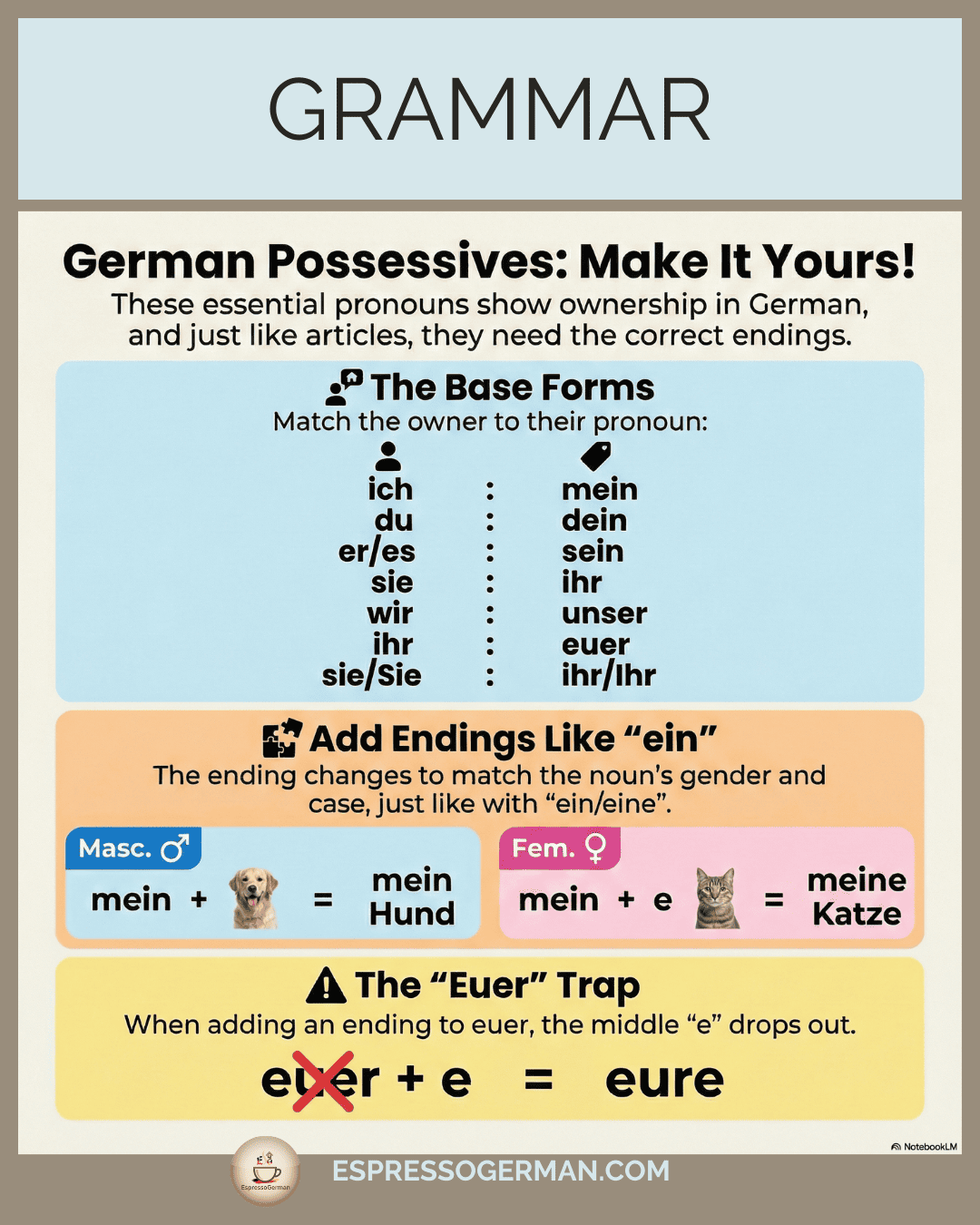
These pronouns indicate ownership.
They are basically adjectives: "My car", "Your cat".
Because they stand before a noun, they behave exactly like the indefinite article Ein.
1. The Base Forms (Memorize these!) 🧱
| English | German Base | Note |
|---|---|---|
| I (My) | Mein | Just like English "Mine" |
| You (Your) | Dein | Rhymes with Mein |
| He (His) | Sein | - |
| She (Her) | Ihr | ⚠️ Watch out! Same as "You (Plural)" |
| It (Its) | Sein | Same as He! |
| We (Our) | Unser | - |
| You all (Your) | Euer | - |
| They (Their) | Ihr | - |
| You (Formal) | Ihr | Capitalized! |
[!CAUTION]
The "Ihr" Confusion
Ihr can mean:
- Her (Das ist ihr Auto)
- Their (Das ist ihr Auto)
- You guys (Seid ihr fertig?) - Personal Pronoun
- Your (Formal) (Ist das Ihr Auto?)
Context is your only friend here.
2. The Endings (The "Ein" Logic) 🧩
Take the base (Mein) and add the ending from the Ein-words table.
Nominative (Subject)
- Masc: Das ist mein Hund. (No ending)
- Fem: Das ist meine Katze. (-e)
- Neut: Das ist mein Haus. (No ending)
- Plural: Das sind meine Kinder. (-e)
Accusative (Direct Object)
Only Masculine changes!
- Masc: Ich sehe meinen Drucker. (-en)
- Fem: Ich sehe meine Tante. (-e)
- Neut: Ich sehe mein Auto. (No ending)
Dative (Receiver)
- Masc/Neut: Mit meinem Hund. (-em)
- Fem: Mit meiner Mutter. (-er)
- Plural: Mit meinen Freunden. (-en)
The "Euer" Trap 🪤
When you add an ending to Euer, the middle "e" runs away because it's lazy.
- Euer + e -> Eure (Not Euere)
- Euer + en -> Euren (Not Eueren)
- Unser is chill, it usually keeps the e (Unsere), but colloquial speech drops it (Unsre).
The Genitive Level 🎩
Yes, Possessive Pronouns also exist in Genitive!
They take the exact same endings as the Genitive Articles (des/der).
- Masc/Neut: Das ist das Auto m{ein}es Vaters. (Endings: -es).
- Fem/Plural: Das ist das Auto m{ein}er Mutter. (Ending: -er).
If you can handle des/der, you can handle meines/meiner.
See also...
- Personal Pronouns — The owners.
- Genitive Case — Showing possession with nouns.