
Gender Markers — The Secret Cheatsheet 🕵️♀️
While German noun genders can seem random, many word endings provide reliable clues. For example, nouns ending in -ung, -heit, -keit, or -schaft are almost always feminine (die). Nouns ending in -ling or -ism are usually masculine (der), and -chen or -lein are always neuter (das).
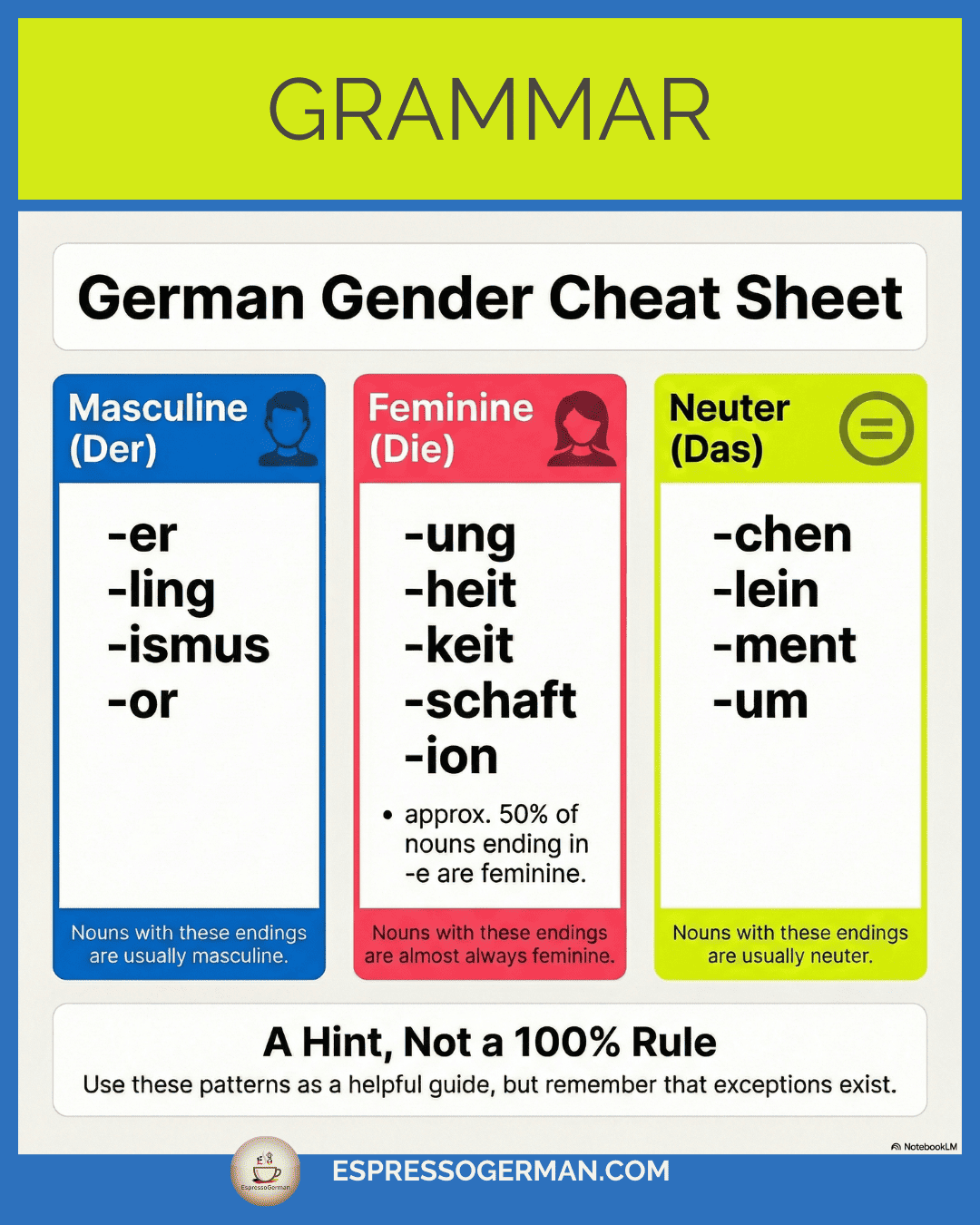
Okay, I told you that gender is random. But that was a little lie.
There are patterns! If you look at the ending (suffix) of a word, you can often predict the gender with near 100% accuracy.
Here is your weapons-grade cheatsheet. ⚔️
1. 100% Feminine (Die) 👩🔴
If a word ends in these, it is DIE. No questions asked.
| Ending | Example | Translation |
|---|---|---|
| -heit | die Freiheit | Freedom |
| -keit | die Möglichkeit | Possibility |
| -ung | die Zeitung | Newspaper |
| -schaft | die Freundschaft | Friendship |
| -ion | die Religion | Religion |
| -tät | die Realität | Reality |
| -ik | die Musik | Music |
| -enz / -anz | die Intelligenz | Intelligence |
[!TIP]
Rhyme it! "Heit, Ung, Keit, all are Die, alright?" (Okay, my rapping skills need work, but you get the idea). These endings are gold.
2. 100% Masculine (Der) 👨🔵
mostly for people or distinct concepts.
| Ending | Example | Translation |
|---|---|---|
| -er | der Lehrer | Teacher (Jobs) |
| -ist | der Polizist | Police Officer |
| -ling | der Schmetterling | Butterfly |
| -or | der Motor | Motor |
| -ismus | der Kapitalismus | Capitalism |
3. 100% Neuter (Das) 👶🟢
Small things and abstract concepts.
| Ending | Example | Translation |
|---|---|---|
| -chen | das Brötchen | Little bread / Roll |
| -lein | das Büchlein | Little book |
| -ment | das Instrument | Instrument |
| -tum | das Eigentum | Property |
| -um | das Museum | Museum |
[!NOTE]
-chen & -lein make everything small (Diminutives). And they make everything Neuter.
- Der Tisch (Table) ➔ Das Tischchen (Small table).
- Die Frau (Woman) ➔ Das Fräulein (Miss/Little woman - largely outdated, but grammar holds).
4. The "Maybe" Endings (The 80% Rule) 🎰
These are good bets, but have exceptions.
- -e ➔ Usually Feminine (~90%).
- die Lampe, die Tasche, die Reise.
- Exceptions: der Name, der Käse, das Auge.
- Ge- ➔ Often Neuter (Collective nouns).
- das Gebäude (building), das Gespräch (conversation).
- Exceptions: der Gedanke, die Geschichte.
5. Topic Groups
Sometimes the meaning helps.
- Days / Months / Seasons ➔ Always Der. (Der Montag, Der Juli, Der Sommer).
- Car Brands ➔ Always Der. (Der BMW, Der Audi).
- Motorcycle Brands ➔ Always Die. (Die Harley).
- Alcohol ➔ Usually Der. (Der Wein, Der Wodka). Exception: Das Bier! 🍺
- Nouns from Verbs ➔ Always Das. (Das Essen - the eating/food, Das Laufen).
See also...
- Compound Nouns — What happens when we glue words together?
Ready to practice?
Master Der, Die, Das with our interactive quiz!