
Accusative Case — The Object 🎯
The Accusative case identifies the direct object of a sentence—the person or thing directly receiving the action. In this case, only masculine articles change (der becomes den, ein becomes einen). Feminine, neuter, and plural articles remain exactly the same as in the Nominative.
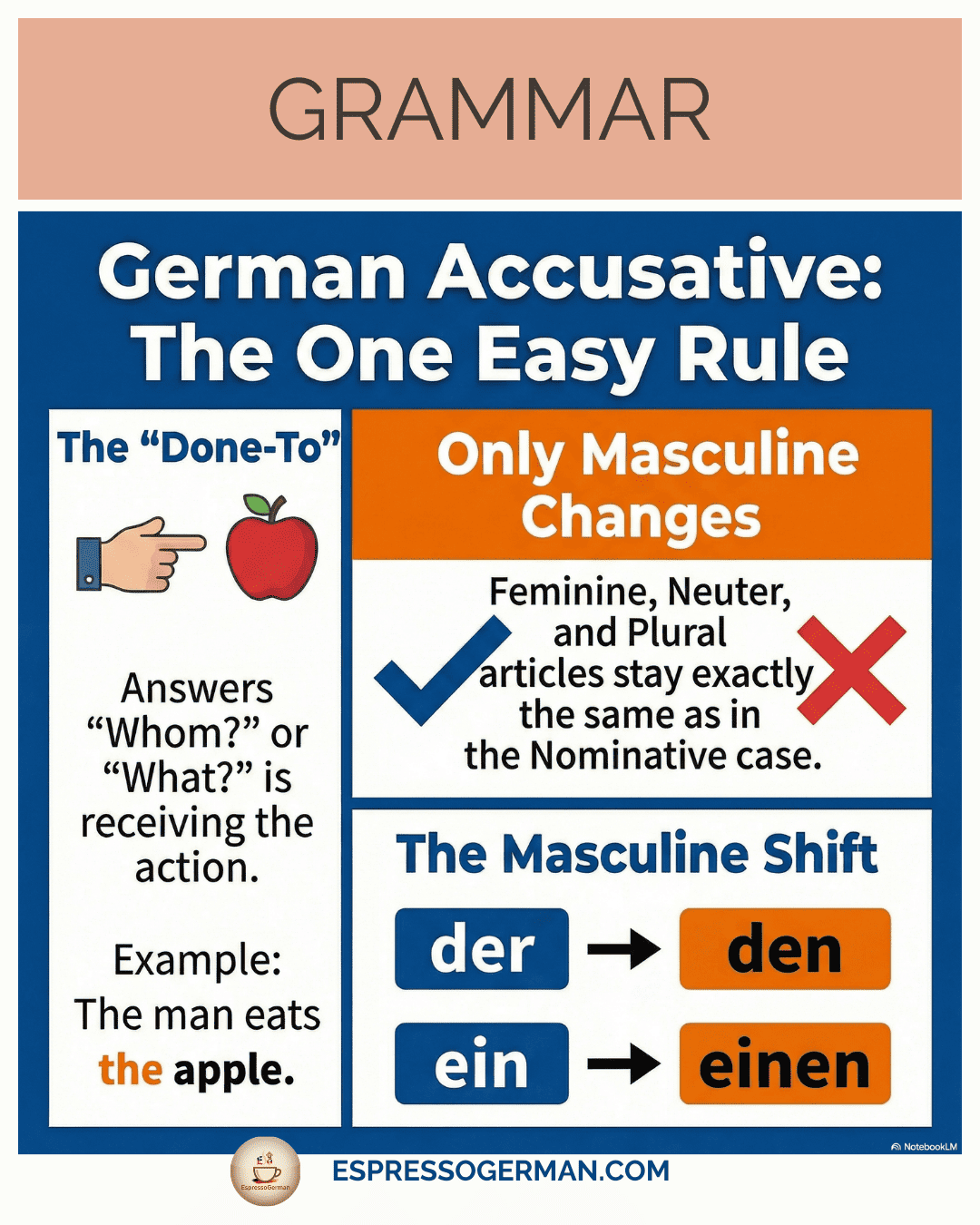
Now things get interesting. The Accusative describes the Direct Object.
This is the thing or person that is being acted upon.
- Der Mann beißt den Hund. (The man bites the dog).
- Der Mann = Subject (Nominative).
- Den Hund = Object (Accusative). It is being bitten. Ouch.
The Secret: Only One Thing Changes ☝️
German grammar has a reputation for being hard, but look at this table.
How many changes do you see compared to Nominative?
| Gender | Definite (The) | Change? | Indefinite (A/An) | Change? |
|---|---|---|---|---|
| Masculine | den Mann | ✅ YES | einen Mann | ✅ YES |
| Feminine | die Frau | ❌ No | eine Frau | ❌ No |
| Neuter | das Kind | ❌ No | ein Kind | ❌ No |
| Plural | die Kinder | ❌ No | - Kinder | ❌ No |
ONLY MASCULINE CHANGES!
Everything else stays exactly the same as in Nominative.
- Der becomes Den.
- Ein becomes Einen.
[!TIP]
Mnemonics: The masculine article gets an -n. Like "N" for "Nooo, don't bite me!" (Okay, maybe that's a stretch). But remember: Der ➔ Den.
When do I use it?
1. Direct Objects
Most verbs take a direct object.
- haben (to have): Ich habe einen Tisch.
- sehen (to see): Ich sehe den Mann.
- essen (to eat): Ich esse den Apfel.
2. Specific Prepositions
These words ALWAYS trigger Accusative. Memorize them with the acronym FUDGE (sort of).
Für (for)
Um (around/at)
Durch (through)
Gegen (against)
Entlang (along)
Oh, and Ohne (without) and Bis (until).
Das ist für den Mann. (For the man).
Ich gehe ohne dich. (Without you).
Personal Pronouns (Accusative)
- mich (me)
- dich (you)
- ihn (him) — CHANGE!
- sie (her)
- es (it)
- uns (us)
- euch (you all)
- sie (them)
Common Mistakes ⚠️
- The "Es gibt" Trap: The phrase Es gibt (there is/are) ALWAYS triggers Accusative!
- Es gibt einen Grund. (There is a reason).
- Es gibt einen Mann.
- Thinking "Das" changes: Remember, Die and Das do NOT change.
- Ich sehe das Auto. (Correct).
- Ich sehe den Auto? (WRONG!).
See also...
- Dative Case — The Indirect Object (giving things to people).
- Prepositions — More details on Für, Ohne, etc.
Ready to practice?
Practice your case endings now!