
Passive Voice — It Is Done 🤖🏗️
The Passive Voice focuses on an action rather than who is doing it. In German, it is formed using the auxiliary verb werden (conjugated) combined with the Past Participle placed at the very end of the sentence. (Das Haus wird gebaut).
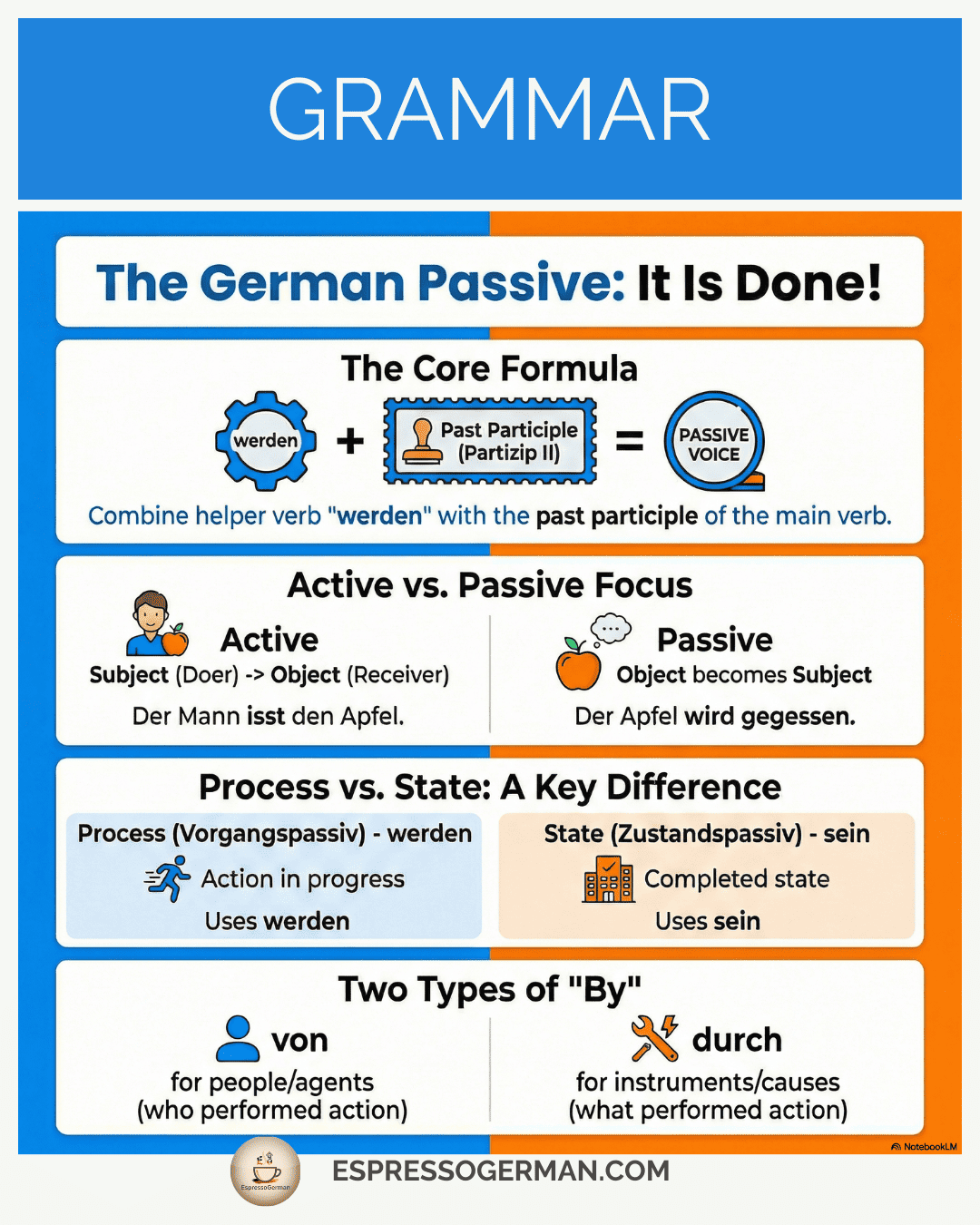
Active: "The man eats the apple." (Der Mann isst den Apfel).
Passive: "The apple is being eaten." (Der Apfel wird gegessen).
In Passive, the Subject (Doer) becomes unimportant or invisible.
The Object (Receiver) becomes the superstar.
The Formula: Werden + Participle II
You need the helper verb Werden (to become) and the past participle (ge-word).
| Tense | Helper (Werden) | End | Example |
|---|---|---|---|
| Present | wird | gemacht | Das Auto wird repariert. |
| Simple Past | wurde | gemacht | Das Auto wurde repariert. |
| Perfect | ist | gemacht worde | Das Auto ist repariert worden. |
[!NOTE]
Who did it? (Von vs. Durch)
If you want to mention the doer:
- Von: Use for people/agents. (Das Auto wird von dem Mechaniker repariert.)
- Durch: Use for instruments/causes. (Das Fenster wurde durch den Wind geöffnet.)
Process vs. State (Vorgang vs. Zustand) 🚂 vs 🧘
German separates "Being done" and "Is done".
1. Process Passive (Vorgangspassiv)
Something is happening RIGHT NOW.
- Die Tür wird geöffnet. (The door is being opened - I can see it moving).
- Helper: Werden.
2. State Passive (Zustandspassiv)
It is already finished. I see the result.
- Die Tür ist geöffnet. (The door is open).
- Helper: Sein (is).
The "Man" Alternative 🏃♂️
In spoken German, we often avoid the Passive by using man (one/people).
- Passive: Hier wird getanzt. (Here is being danced).
- Active (Man): Hier tanzt man. (Here one dances).
Both mean the same thing: "Dancing is happening here."
Passive with Modal Verbs 🏗️
This is advanced stuff (B1/B2).
- Das Haus muss renoviert werden. (The house must be renovated).
- Formula: Muss (Pos 2) + Participle + Werden (End).
See also...
- Future Tense — Uses "Werden" + Infinitive. Don't confuse them!
- Participle II — How to form the ge-words.