
Subordinate Clauses — The Sidekicks 🦸♂️🦸♀️
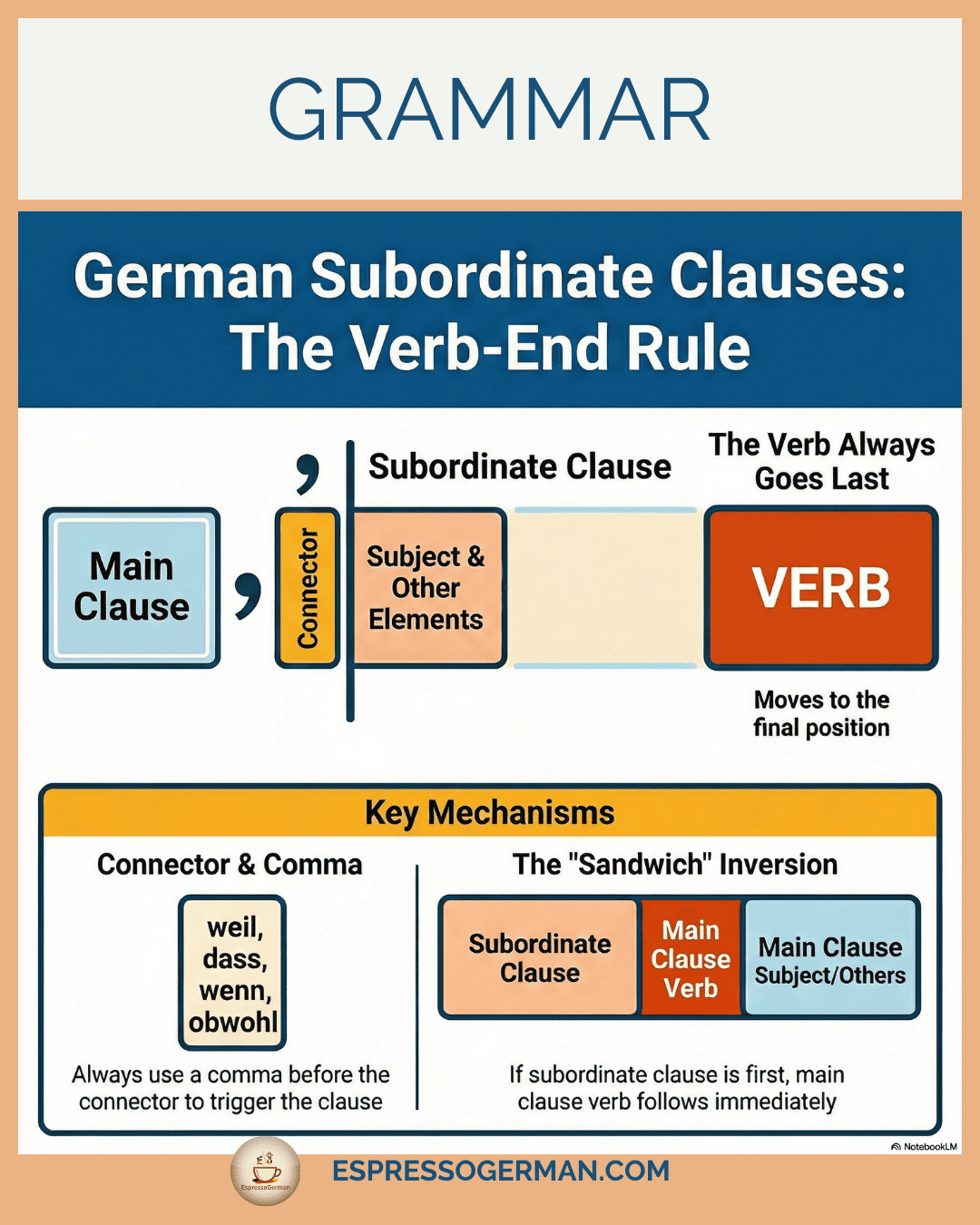
A subordinate (dependent) clause provides extra context but cannot stand alone as a complete sentence. The defining grammatical feature is that the conjugated verb is kicked to the absolute end. If you start a sentence with a subordinate clause, the main clause immediately begins with its verb.
A Main Clause (Hauptsatz) can stand alone. "I am hungry."
A Subordinate Clause (Nebensatz) cannot. "Because I didn't eat."
In German, these sidekicks have one golden rule: The Verb goes to the END.
The Structure 🏗️
Main Clause + Comma + Connector + ... + Verb.
- Ich bin müde, weil ich gestern zu lange gearbeitet habe.
- Connector: weil.
- Verb group: gearbeitet habe (End).
Types of Subordinate Clauses
- Causal (Reason): weil, da (because).
- Conditional (Condition): wenn, falls (if).
- Temporal (Time): als, bevor, nachdem (when, before, after).
- Concessive (Contrast): obwohl (although).
- Final (Purpose): damit (so that).
Quick Connector Reference 📖
Memorize these. They ALWAYS kick the verb.
| Connector | Meaning | Example |
|---|---|---|
| weil | because | ...weil ich Hunger habe. |
| wenn | if/when | ...wenn es regnet. |
| dass | that | ...dass du nett bist. |
| ob | whether | ...ob er kommt. |
| obwohl | although | ...obwohl er reich ist. |
| da | since/because | ...da ich keine Zeit habe. |
The "Sandwich" Effect 🥪
If you put the Sidekick first, the Main Clause gets inverted.
- [Weil ich müde bin], gehe ich ins Bett.
- Basically: The whole subordinate clause acts as Position 1 of the main sentence.
- Therefore, the Main Verb must follow immediately at Position 2.
[!TIP]
Comma Rule: German LOVES commas. You usually need a comma before the connector (, weil / , dass / , wenn). In English, we often skip it. In German, it's mandatory.
See also...
- Conjunctions Detailed — The list of connectors.
- Relative Clauses — A specific type of side sentence.
Ready to practice?
Practice word order with scrambled sentences!