
Relative Clauses — The Detailed Description 🧬
Relative clauses start with a relative pronoun (der, die, das) that refers back to a noun in the main clause. Like all dependent clauses, they kick the conjugated verb to the end. The relative pronoun must match the gender and number of the noun it describes.
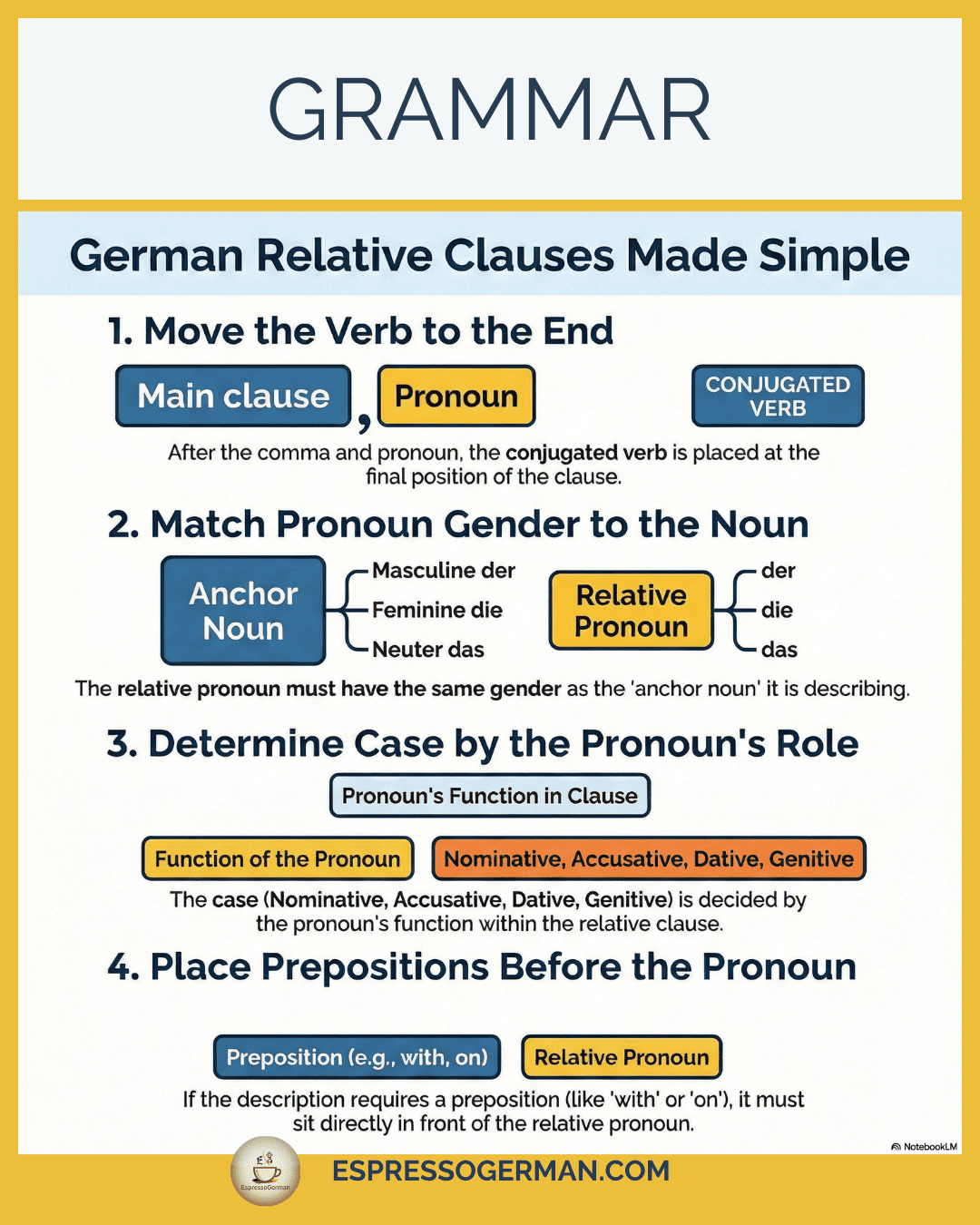
We use Relative Clauses to describe a noun more precisely without starting a new sentence.
- "The man, who is wearing a hat."
In German, this is a Subordinate Clause -> Verb at the End!
The Formula 🧪
Main Clause + Comma + Relative Pronoun + ... + Verb.
- Das ist der Mann, der den Hut trägt. (That is the man, who the hat wears).
- Das ist das Auto, das ich kaufen will.
Choosing the Pronoun
You need to check the Relative Pronouns table.
- Gender: Matches the Anchor Noun (The thing you describe).
- Case: Matches the Role inside the relative clause.
Example
Der Hund, ... ich sehe.
- Anchor: Der Hund (Masculine).
- Role: Ich sehe ... HIM. (Accusative object).
- Masc + Acc = den.
Der Hund, den ich sehe...
Prepositions in Relative Clauses
If the verb needs a preposition, it drags it along.
- Das ist die Frau, mit der ich gesprochen habe.
- Das ist der Stuhl, auf dem ich sitze. (Dative because "Sitzing" is static!).
Nested Sentences (The German Nightmare) 🕸️
Germans love to put relative clauses inside other sentences.
- Der Mann, [der dort steht], ist mein Vater.
- Main sentence: Der Mann ... ist mein Vater.
- Insertion: ... der dort steht ...
See also...
- Relative Pronouns — The declension table.
- Word Order — Basic rules.