
Fixed Prepositions — The Verb's Best Friend 🤞🔗
Many German verbs are intrinsically linked to specific prepositions that don't always translate directly to English. For example, 'warten auf' (to wait for) or 'sich erinnern an' (to remember). You must memorize the verb, its preposition, and the required case together.
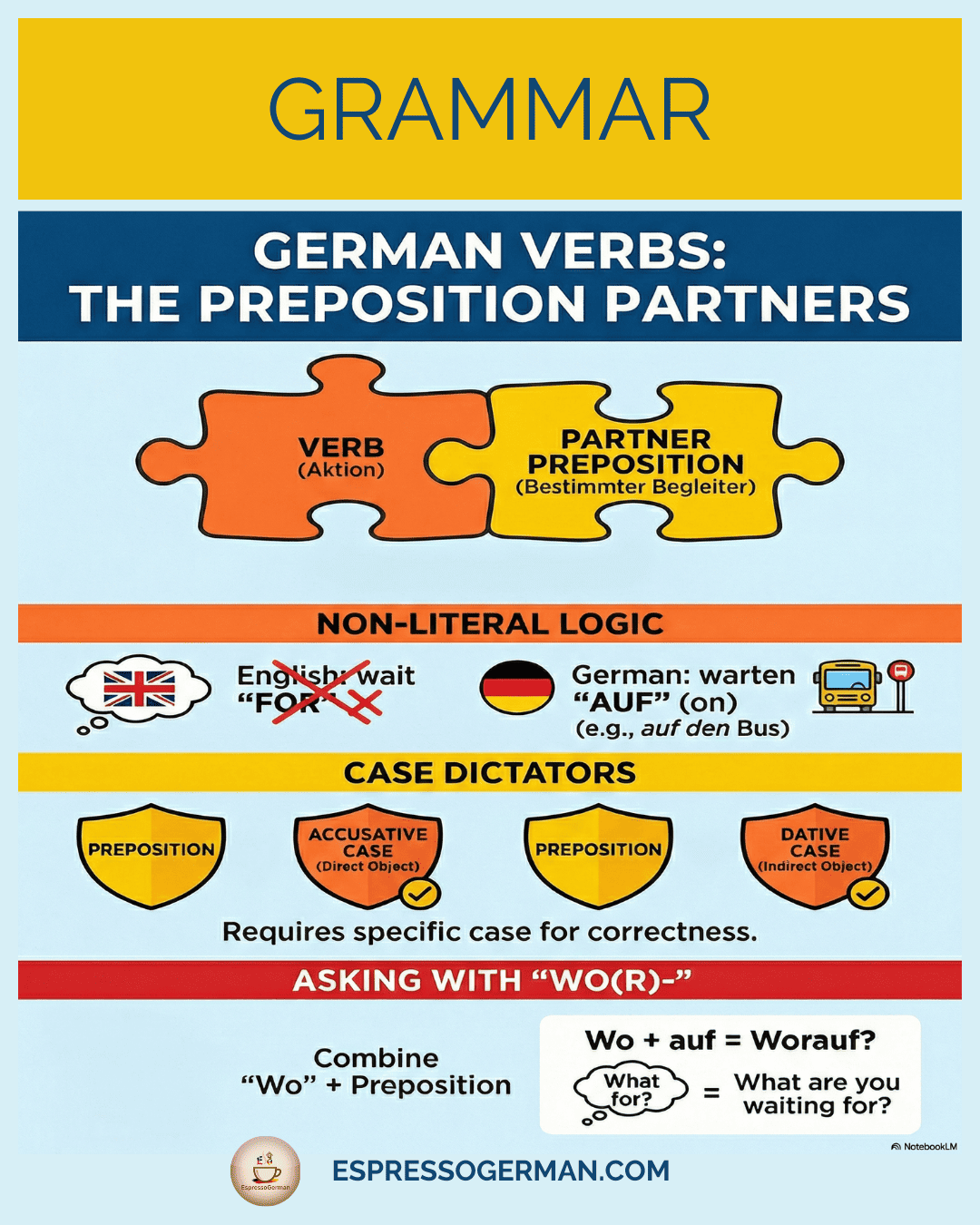
Some verbs in German are lonely. They refuse to go out unless they can bring their specific preposition with them. We call these Fixed Prepositions. It’s not just "waiting," it’s "waiting for." ⏳
Why is it hard? 😫
Unlike in English, the prepositions don't always match up.
- English: I wait for the bus.
- German: Ich warte auf den Bus. (Literally: "on" the bus).
If you say Ich warte für den Bus, a German might think you are waiting on behalf of the bus because the bus is busy. 🚌💨
Common Verb + Preposition Combinations
| Verb | Preposition | Case | Meaning | Example |
|---|---|---|---|---|
| warten | auf | Acc | to wait for | Ich warte auf dich. |
| denken | an | Acc | to think of | Ich denke an dich. |
| sprechen | mit | Dat | to speak with | Ich spreche mit dir. |
| sprechen | über | Acc | to speak about | Wir sprechen über das Wetter. |
| sich freuen | auf | Acc | look forward to | Ich freue mich auf den Sommer. |
| sich freuen | über | Acc | be happy about | Ich freue mich über das Geschenk. |
| träumen | von | Dat | to dream of | Ich träume von dir. |
| angst haben | vor | Dat | be afraid of | Ich habe Angst vor Spinnen. |
💡 The "Wo-" Question Hack
How do you ask "What are you waiting for?"
You can't say Für was wartest du? (Wrong!)
You combine the preposition with Wo-:
- Auf + was = Worauf wartest du? (What are you waiting for?)
- Über + was = Worüber recht ihr? (What are you talking about?)
Note: If the preposition starts with a vowel (like auf or über), add an extra -r- to make it smooth. Wo-r-auf.
See also...
- Pronominal Adverbs — The answer to "Worauf?".
- Two-Way Prepositions — Many fixed prepositions use the Accusative form of these!
Ready to practice?
Train your preposition usage!