
Pronouns (Pronomen) — The Stunt Doubles 👯
Pronouns are placeholder words that stand in for nouns, preventing unnecessary repetition. Whether personal (ich/du), possessive (mein/dein), or demonstrative, German pronouns must adjust their endings based on the gender and case of the noun they replace.
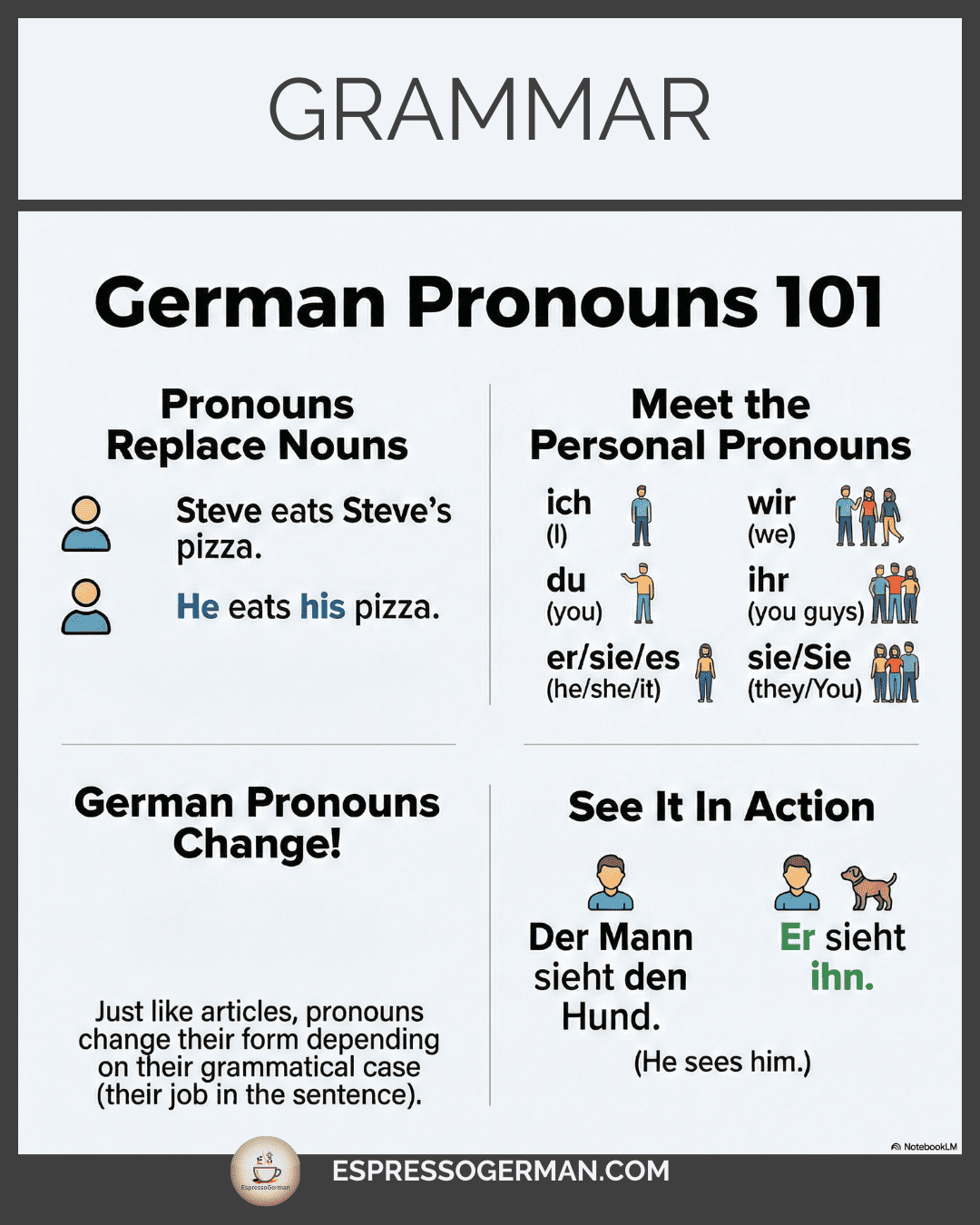
Pro-Nouns are words that stand Pro (for) a Noun.
Instead of saying "Peter gives Peter's dog to Peter's dad", you say "He gives his dog to him."
1. Personal Pronouns (The Actors) 🎭
- ich, du, er, sie, es, wir, ihr, sie.
- "Er liebt sie."
2. Possessive Pronouns (The Owners) 🔑
- mein, dein, sein, ihr...
- "Das ist mein Haus."
3. Reflexive Pronouns (The Mirror) 🪞
- mich, dich, sich...
- "Ich wasche mich." (I wash myself).
4. Relative Pronouns (The Connectors) 🔗
- der, die, das... (in a side sentence).
- "Der Mann, der hier wohnt." (The man, who lives here).
5. Indefinite Pronouns (The Vague Ones) 👻
- jemand, niemand, etwas...
- "Jemand hat meinen Kuchen gegessen!" (Someone ate my cake).
Why are they hard?
Because you need to choose the right box in the matrix:
- Person: (1st, 2nd, 3rd)
- Gender: (Masc, Fem, Neut)
- Case: (Nom, Acc, Dat)
👉 Deep Dive: Visit the Pronouns Hub for detailed tables.
6. The Politeness Trap (Du vs. Sie) 🎩
German has two words for "You".
- Du: Informal. For friends, family, children, and God.
- Sie: Formal. For strangers, bosses, police officers.
Important:
- Sie is capitalized.
- sie (lowercase) means "she" or "they".
- Context usually clears this up, but the ending of the verb is key!
- Sie kommen. (You come / They come).
- Sie kommt. (She comes).
See also...
- Personal Pronouns — Start here.