
Conjunctions (Konjunktionen) — The Glue 🥣🔗
Conjunctions are connecting words (und, oder, weil, dass). Some simply link two sentences without disrupting the grammar (coordinating), while others (subordinating) fundamentally change the sentence structure by sending the conjugated verb to the very end.
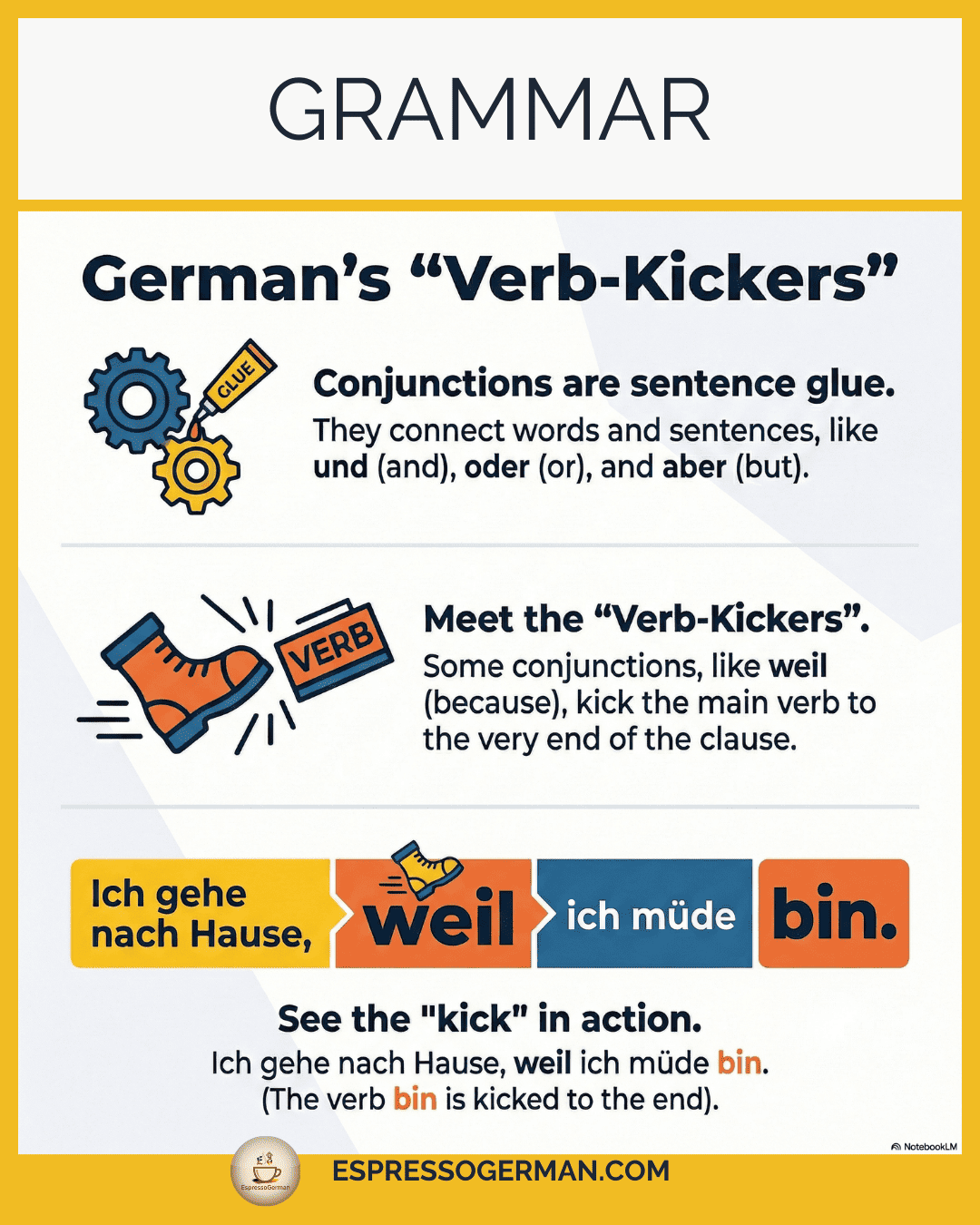
Conjunctions connect words, phrases, or sentences.
"I like cats and dogs."
"I eat because I am hungry."
In German, conjunctions are critical because they affect Word Order.
1. Coordinating (Position 0) 🛤️
These connect two main sentences equally. They do NOT count as a position.
(ADUSO Rule).
- Und (and)
- Aber (but)
- Oder (or)
- Denn (because)
- Sondern (but rather)
[Ich bin müde], aber [ich arbeite].
2. Subordinating (The Kickers) ⚽
These start a "Side Sentence" (Nebensatz) and kick the verb to the END.
- Weil (because)
- Dass (that)
- Wenn (if/when)
- Ob (whether)
[Ich arbeite], weil [ich Geld brauche]. (Note: brauche is at the end!)
3. Two-Part Connectors (The Twins) 👯
These come in pairs.
- Entweder ... oder (Either ... or)
- Sowohl ... als auch (Both ... and)
👉 Deep Dive: Master the rules in the Structure Category.
4. Spoken German Hacks 🗣️
In reality, Germans sometimes break the rules.
With weil (because), you will often hear people staring a new Main Clause (Verb at Position 2).
- Ich komme nicht, weil... ich bin müde. (Pause after weil).
- Correct grammar: ...weil ich müde bin.
Use the correct version in writing!
5. Starting a Sentence
Can you start a sentence with "Und"? YES!
It's perfectly fine stylistically.
- Und dann bin ich gegangen. (And then I left).
See also...
- Word Order — How sentences are built.
- Subordinate Clauses — Where verbs go.