
Adverbs (Adverbien) — The Modifiers ⚡🐢
Adverbs modify verbs, adjectives, or other adverbs, describing how, when, where, or why an action occurs (e.g., heute, sehr, schnell). Unlike adjectives sitting in front of nouns, German adverbs never take declension endings; their form remains constant.
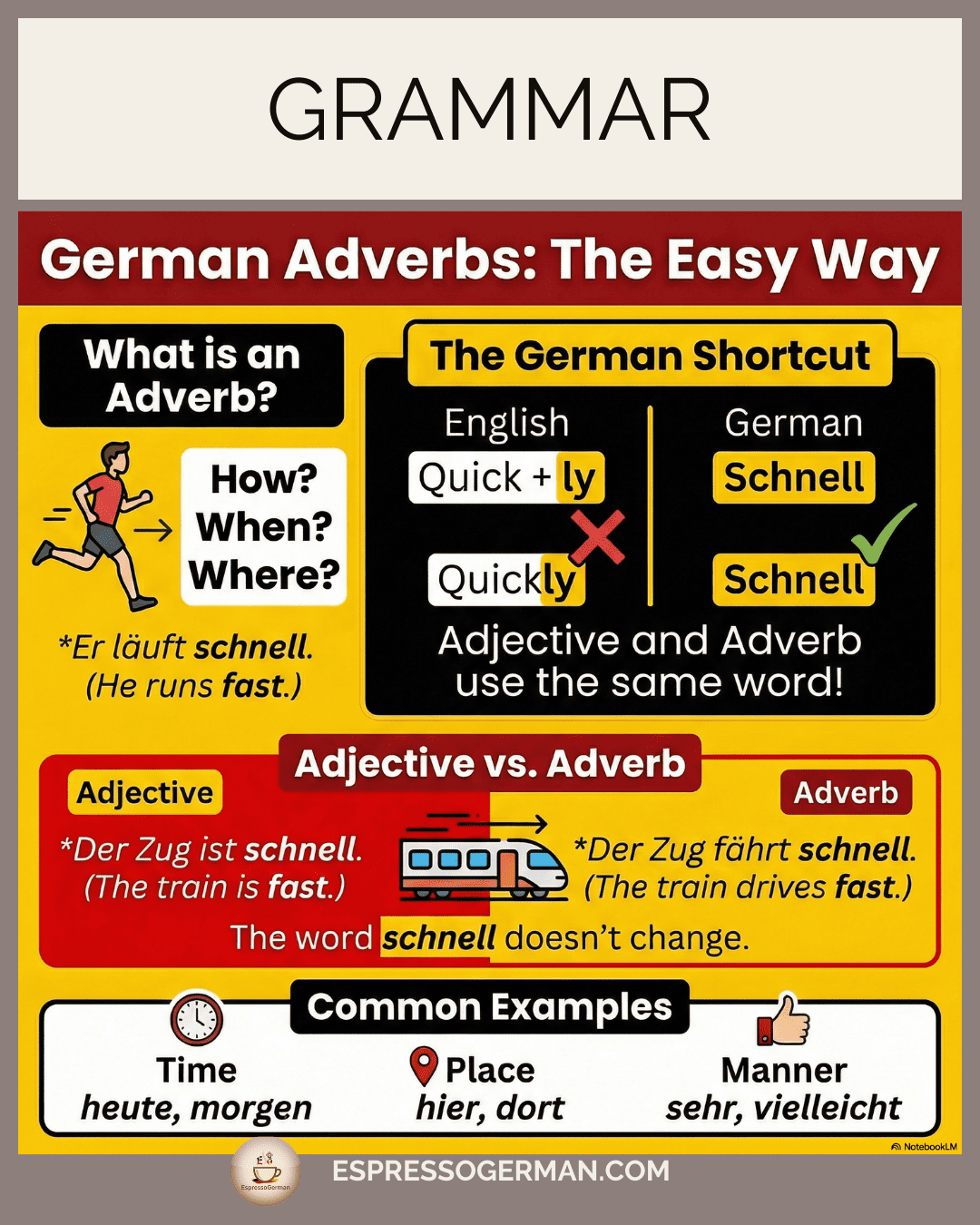
Adjectives describe Nouns ("The fast car").
Adverbs describe Verbs, Adjectives, or other Adverbs.
"He drives fast." "That is very good."
1. No Endings! 🎉
The best thing about Adverbs? They NEVER change.
No declension tables. No gender.
- Das Auto ist schnell. (Adjective used as Adverb).
- Er läuft schnell. (Adverb).
- Sie läuft schnell. (Adverb).
2. Temporal Adverbs (Time) ⏰
When?
- heute (today)
- morgen (tomorrow)
- jetzt (now)
- immer (always)
- nie (never)
3. Local Adverbs (Place) 📍
Where?
- hier (here)
- da (there)
- draußen (outside)
- oben (upstairs)
4. Modal Adverbs (Manner) 🎭
How?
- gerne (gladly/like to)
- leider (unfortunately)
- vielleicht (maybe)
[!TIP]
Gern(e) is special.
English says "I like to play".
German says "I play gladly". (Ich spiele gern).
5. Adjective vs. Adverb Table ⚔️
How to tell them apart?
| Sentence | Function | Type |
|---|---|---|
| Der Hund ist schnell. | Describes Noun (indirectly) | Adjective (Predicative) |
| Der schnelle Hund. | Describes Noun (directly) | Adjective (Attributive) |
| Der Hund rennt schnell. | Describes Verb | Adverb |
| Der Hund ist sehr schnell. | Describes Adjective | Adverb |
Basically: If it has an ending (-e, -em, -er), it's an Adjective. If it never changes, it's acting as an Adverb.
See also...
- Adjectives — The ones that DO change.
- Word Order (TeKaMoLo) — Where to put adverbs.