
Adjectives (Adjektive) — The Decorators 🎨✨
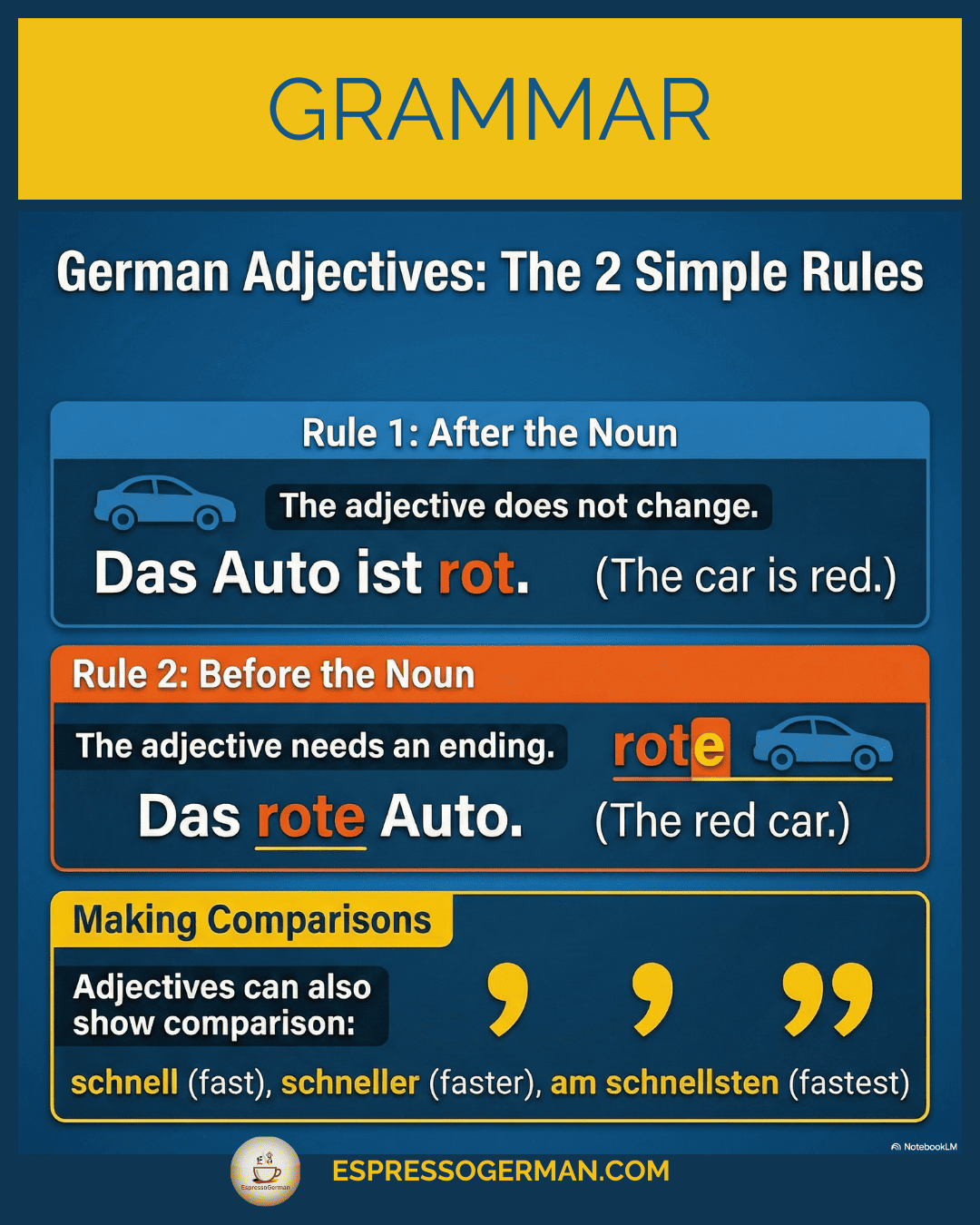
Adjectives describe nouns. When used alone (The car is fast: Das Auto ist schnell), German adjectives don't change at all. But when placed directly before a noun (The fast car: Das schnelle Auto), they must take specific declension endings.
Adjectives describe Nouns. "The red car." "The fast dog."
1. Predicative (Easy Mode) 🟢
If the adjective comes AFTER the verb (usually sein), it does not change.
- Der Mann ist schnell.
- Die Frau ist schnell.
- Das Kind ist schnell.
Simple, right?
2. Attributive (Hard Mode) 🔴
If the adjective is stuck between the Article and the Noun, it needs an ending.
- Der schnell{e} Mann.
- Eine schnell{e} Frau.
- Ein schnell{es} Kind.
This is called Adjective Declension. It depends on Gender, Case, and Article type.
👉 Deep Dive: Master this at Adjective Declension.
3. Comparison (Bigger, Better, Faster) 🚀
Just like English, we have levels.
- Positive: schnell (fast)
- Comparative: schneller (faster) -> Adds -er.
- Superlative: am schnellsten (fastest) -> Adds am ...-sten.
- Gut -> Besser -> Am besten (Good/Better/Best).
4. Useful Opposites ↔️
Learn adjectives in pairs! It doubles your vocabulary.
| Adjective 1 | Meaning | Adjective 2 | Meaning |
|---|---|---|---|
| groß | big | klein | small |
| schnell | fast | langsam | slow |
| teuer | expensive | billig | cheap |
| schön | beautiful | hässlich | ugly |
| laut | loud | leise | quiet |
| hell | bright | dunkel | dark |
| alt | old | neu | new |
See also...
- Adverbs — Describing verbs instead of nouns.
Ready to practice?
Practice adjective endings!