
Indirect Questions — Being Polite 🎩🕵️♀️
Indirect questions embed a question inside another sentence to sound more polite. They use the question word as a subordinating conjunction, which kicks the verb to the end. Example: 'Wo ist der Bahnhof?' becomes 'Können Sie mir sagen, wo der Bahnhof ist?'.
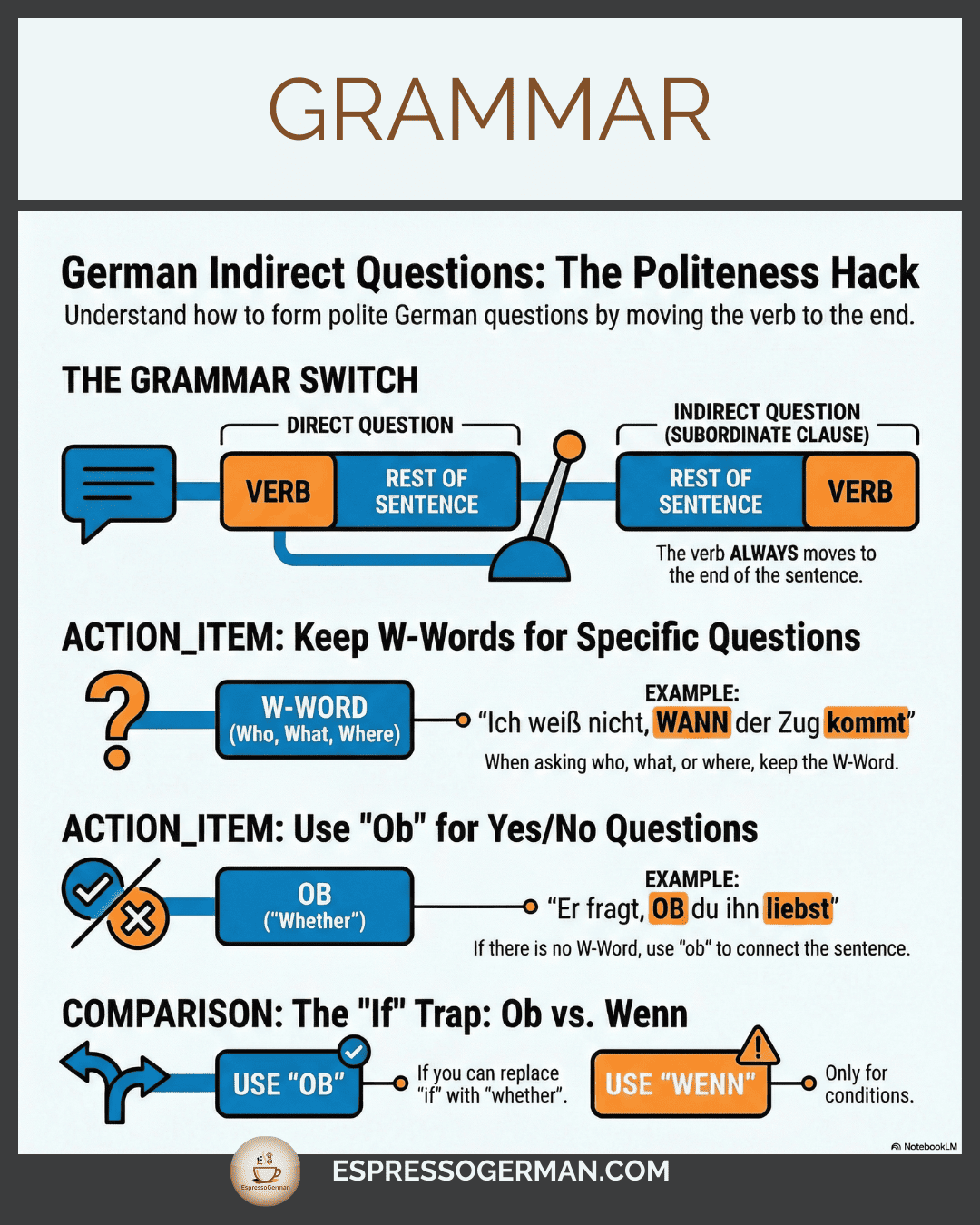
A Direct Question is rude and fast.
- Wo ist der Bahnhof? (Where is the station?)
An Indirect Question is polite and embedded.
- Können Sie mir sagen, wo der Bahnhof ist?
- (Can you tell me, where the station is?)
The Grammar Switch 🔀
Indirect Questions are Subordinate Clauses.
This means the verb moves to the END.
Type 1: W-Questions (Was, Wo, Wer...)
If the direct question has a W-Word, keep it!
- Direct: Wann kommt der Zug?
- Indirect: Ich weiß nicht, wann der Zug kommt.
Type 2: Yes/No Questions (Ob...)
If the direct question has NO W-Word (starts with a verb), use OB (whether/if).
- Direct: Liebst du mich? (Yes/No).
- Indirect: Er fragt, ob du ihn liebst.
- (He asks, whether you love him).
[!CAUTION]
Wenn vs Ob (The "If" Trap)
English uses "if" for both. German separates them.
- Wenn: Condition. (I come if I have time).
- Ob: Yes/No Alternative. (I don't know if he comes).
Test: Can you replace "if" with "whether"? If yes -> Use OB.
Politeness Levels 🎩
| Level | German | English |
|---|---|---|
| Rude/Direct | Wo ist das Klo? | Where is the loo? |
| Polite | Entschuldigung, wo ist das Klo? | Excuse me, where is the loo? |
| Very Polite (Indirect) | Können Sie mir sagen, wo das Klo ist? | Could you tell me where the loo is? |
| Fancy (Indirect) | Mich würde interessieren, wo sich das WC befindet. | I would be interested to know where the WC is located. |
Use Indirect Questions when talking to strangers, authorities, or asking for favors.
Common Intro Phrases
- Ich weiß nicht, ...
- Können Sie mir sagen, ...
- Mich interessiert, ...
- Er hat gefragt, ...
See also...
- Questions — Direct questions.
- Subordinate Clauses — The verb-end rule.