
The German 'R' — The Throat Gargle 🏴☠️🦜
The German 'R' has two main forms. The throat R is used at the beginning of words and before vowels, produced with a slight gargle in the back of the throat. The vocalic R occurs at the end of words (like 'er') and sounds almost like a short 'uh' vowel.
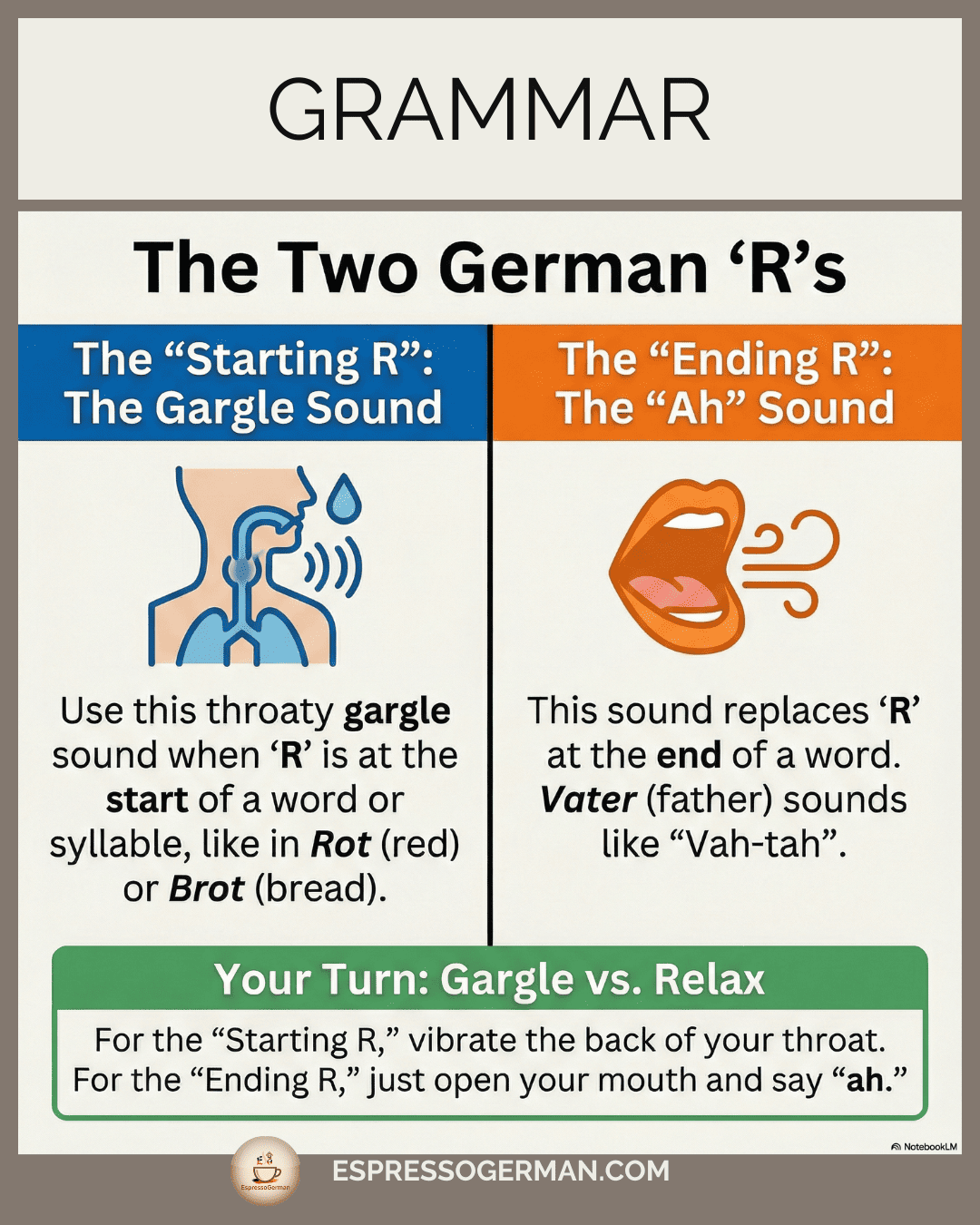
The German R is the most infamous sound in the language. It’s the sound that makes people think German sounds "harsh." But actually, it’s just a gargle! 🥛
The Two R's
German actually has two different R-sounds, depending on where they are in the word.
1. The "Starting R" (Reibe-R) 😖
This is used when the R is at the start of a word or syllable.
- Rot (red), Regen (rain), Brot (bread), Freiburg.
How to do it:
Imagine you are gargling water (or mouthwash). That vibration in the back of your throat? That’s it! It’s not rolled on the tongue like in Spanish or Russian. It’s strictly a throat sound.
- Ra-Re-Ri-Ro-Ru (Gargle it!)
2. The "Ending R" (Vocalic R) 🗣️
This is used when the R is at the end of a word (usually -er).
- Vater (father), Wasser (water), Berlin__er, lecker (tasty).
How to do it:
Don't pronounce it as an R at all! Pronounce it like a light, open "ah".
- Vater sounds like "Vah-tah."
- Wasser sounds like "Vas-sah."
- Bier sounds like "Bee-ah."
💡 The "Lazy Tongue" Tip
For the Ending-R, just let your tongue fall flat and open your mouth slightly. It requires almost zero effort. That’s why Germans love it!
- Der Computer ➔ "Deah Computah"
3. Regional Variations (The Bavarians) 🥨
If you go to Bavaria (South) or Switzerland, the rules change!
They often roll the R with the tip of the tongue (like Spanish/Italian).
- Griaß di! (Hello!) -> Trilled R.
So if you can't do the throat gargle, just pretend you are Bavarian. Problem solved.
4. Common Mistakes ⚠️
- The American R: Don't curl your tongue back! It sounds like you have a hot potato in your mouth.
- The Hard End: Don't say Vat-errr. Say Vah-tah.
See also...
- Consonant Clusters — Combining R with other letters.
- Final Devoicing — Another ending trick.