
Final Devoicing (Auslautverhärtung) — The Hard Stop 🛑🔨
Final Devoicing (Auslautverhärtung) is a crucial German accent rule. When the voiced consonants B, D, and G appear at the very end of a word or syllable, they are hardened and pronounced like their unvoiced counterparts: P, T, and K (e.g., 'Hund' sounds like 'Hunt').
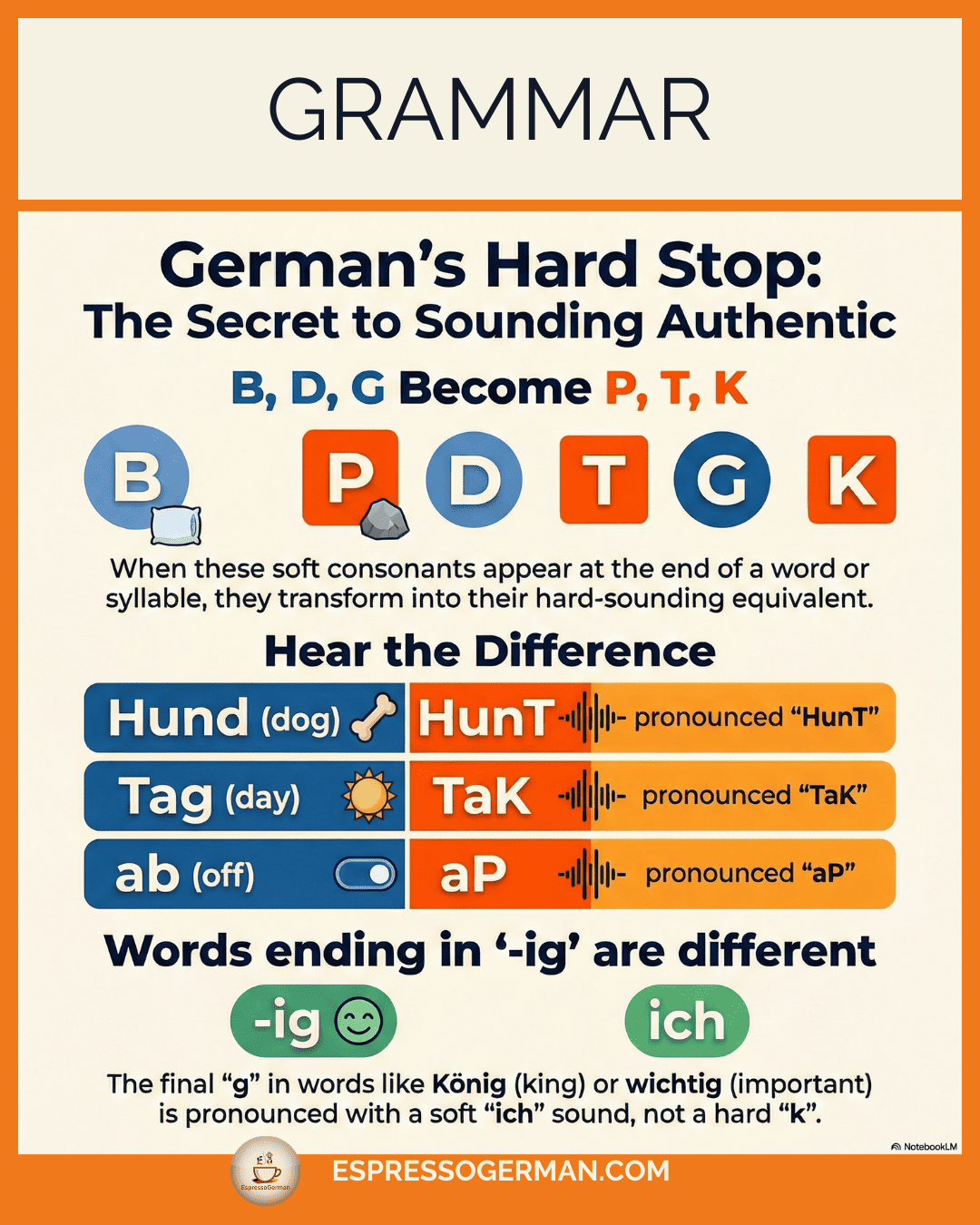
That long German word (Auslautverhärtung) just means "Hardening of the End." In German, soft consonants become hard when they appear at the end of a syllable. It gives German its "crisp" and "snappy" sound. 🥨💥
The Transformers 🤖
These letters change their identity at the end of a word:
- B ➔ P
- D ➔ T
- G ➔ K
Examples
The B ➔ P Switch
- Liebe (Love) — Soft B.
- ab (off/from) — Pronounced like "ap".
- Club — Pronounced like "Clup".
The D ➔ T Switch
- Hunde (Dogs) — Soft D.
- Hund (Dog) — Pronounced like "Hunt".
- Rad (Wheel) — Pronounced like "Rat".
The G ➔ K Switch
- Tage (Days) — Soft G.
- Tag (Day) — Pronounced like "Tak".
- Zuug (Train) — Pronounced like "Tsuk".
[!TIP]
Why "Hamburg" is confusing:
You write Hamburg, but you say "Hamburk".
You write Und, but you say "Unt".
💡 The "-ig" Exception
If a word ends in -ig, it’s not a hard K. It becomes the soft "Ich-sound" (hissing cat! 😼).
- König (King) — Pronounced "Kön-ich".
- wichtig (important) — Pronounced "wicht-ich".
- fertig (finished) — Pronounced "fert-ich".
💡 The "Plural Trick" 🕵️♂️
Not sure if a word ends with a D or T? Make it plural!
In the plural form, the vowel pulls the consonant away from the end, so it becomes soft again.
- Rad (Wheel) -> Raaat? Raaad?
- Plural: Räder (Soft D!) -> So singular is written with D.
- Hund (Dog) -> Hunt? Hund?
- Plural: Hunde (Soft D!) -> So singular is written with D.
- Bunt (Colorful) -> Bunt? Bund?
- Plural: Bunte (Still T!) -> So singular is written with T.
See also...
- Consonant Clusters — More consonant rules.
- The German 'R' — The other ending rule.