
Reflexive Pronouns — The Mirror 🪞
Reflexive pronouns refer back to the subject of the sentence (myself, yourself). In German, many verbs require them (e.g., sich waschen - to wash oneself). They are identical to personal pronouns in the Accusative and Dative, except for the third-person 'sich'.
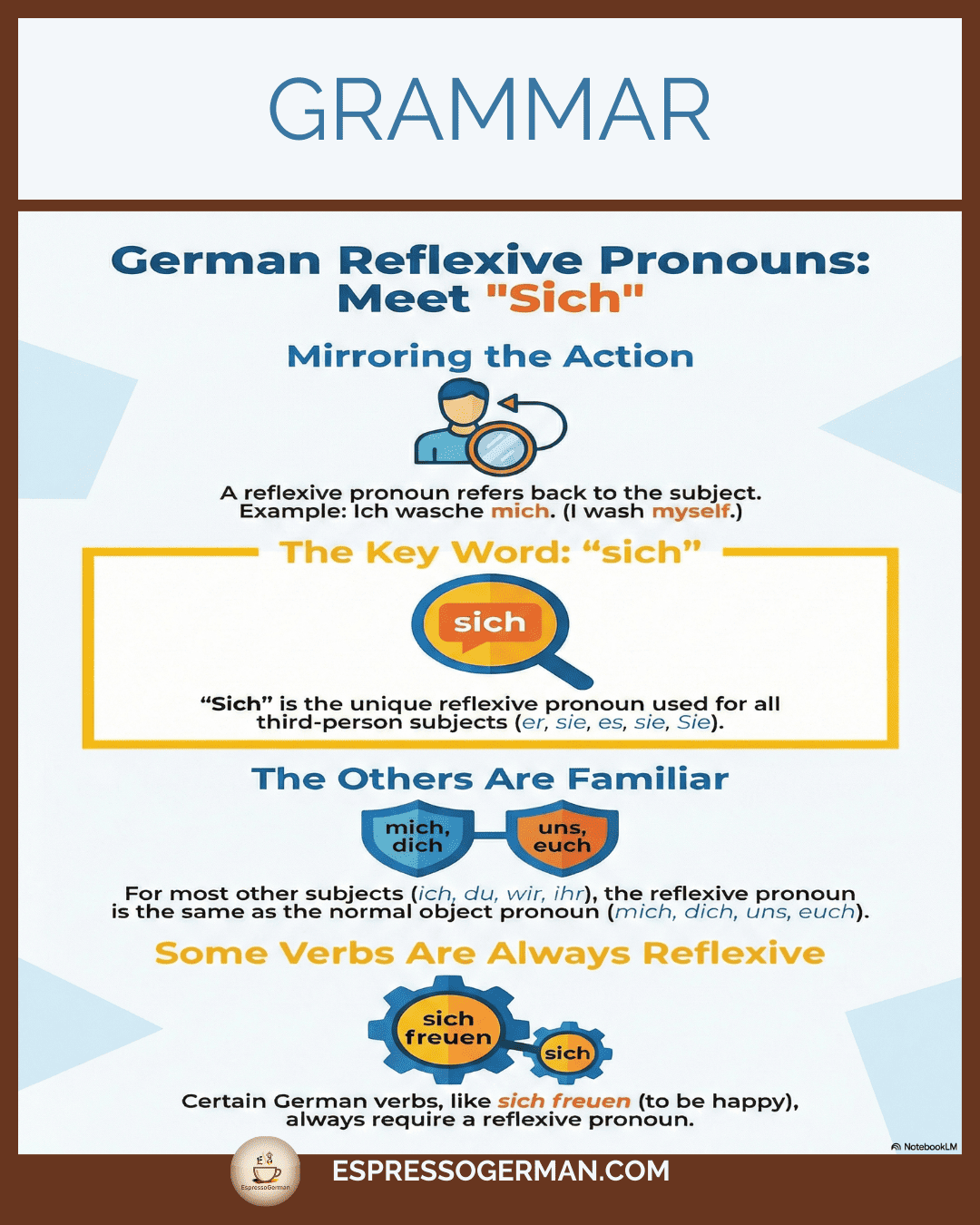
Reflexive means "reflecting back."
The subject performs an action on itself.
- I wash myself.
- She sees herself.
In German, this is huge because many normal verbs are reflexive!
- Ich interessiere mich. (I interest myself = I am interested).
- Ich freue mich. (I 'happy' myself = I am happy).
The Chart 📊
| Person | Accusative | Dative |
|---|---|---|
| ich | mich | mir |
| du | dich | dir |
| er/sie/es | sich | sich |
| wir | uns | uns |
| ihr | euch | euch |
| sie/Sie | sich | sich |
[!TIP]
The Good News:
- Uns, Euch, Sich are the SAME in Accusative and Dative.
- Sich is the only "new" word here. It covers He, She, It, They, and You(Formal).
Accusative vs. Dative Reflexive 🥊
Most reflexive verbs use Accusative (Mich/Dich).
- Ich wasche mich. (I wash myself).
However, if you add a second object (a body part, usually), the person becomes Dative (Mir/Dir).
- Ich wasche mir die Hände. (I wash [to me] the hands).
- Ich putze mir die Zähne. (I brush [to me] the teeth).
Common Reflexive Verbs
You just have to learn these vocab chunks.
- sich freuen (to be happy/look forward) -> Ich freue mich.
- sich ärgern (to be angry) -> Er ärgert sich.
- sich treffen (to meet) -> Wir treffen uns.
- sich setzen (to sit down) -> Setz dich!
- sich fühlen (to feel) -> Ich fühle mich gut.
Reciprocal Actions 🤝
In Plural, it can mean "each other".
- Wir sehen uns. (We see us = We see each other).
- Sie lieben sich. (They love themselves OR They love each other).
- To be clear, say: Sie lieben einander.
See also...
- Personal Pronouns — The base forms.
- Dative Case — Why "Mir"?