
Pronoun Types — The Copycats ♊
Pronouns are a diverse group of words that replace nouns to prevent repetition. In German, they must agree with the gender, number, and case of the noun they are replacing. This overview covers personal, possessive, reflexive, relative, and demonstrative pronouns.
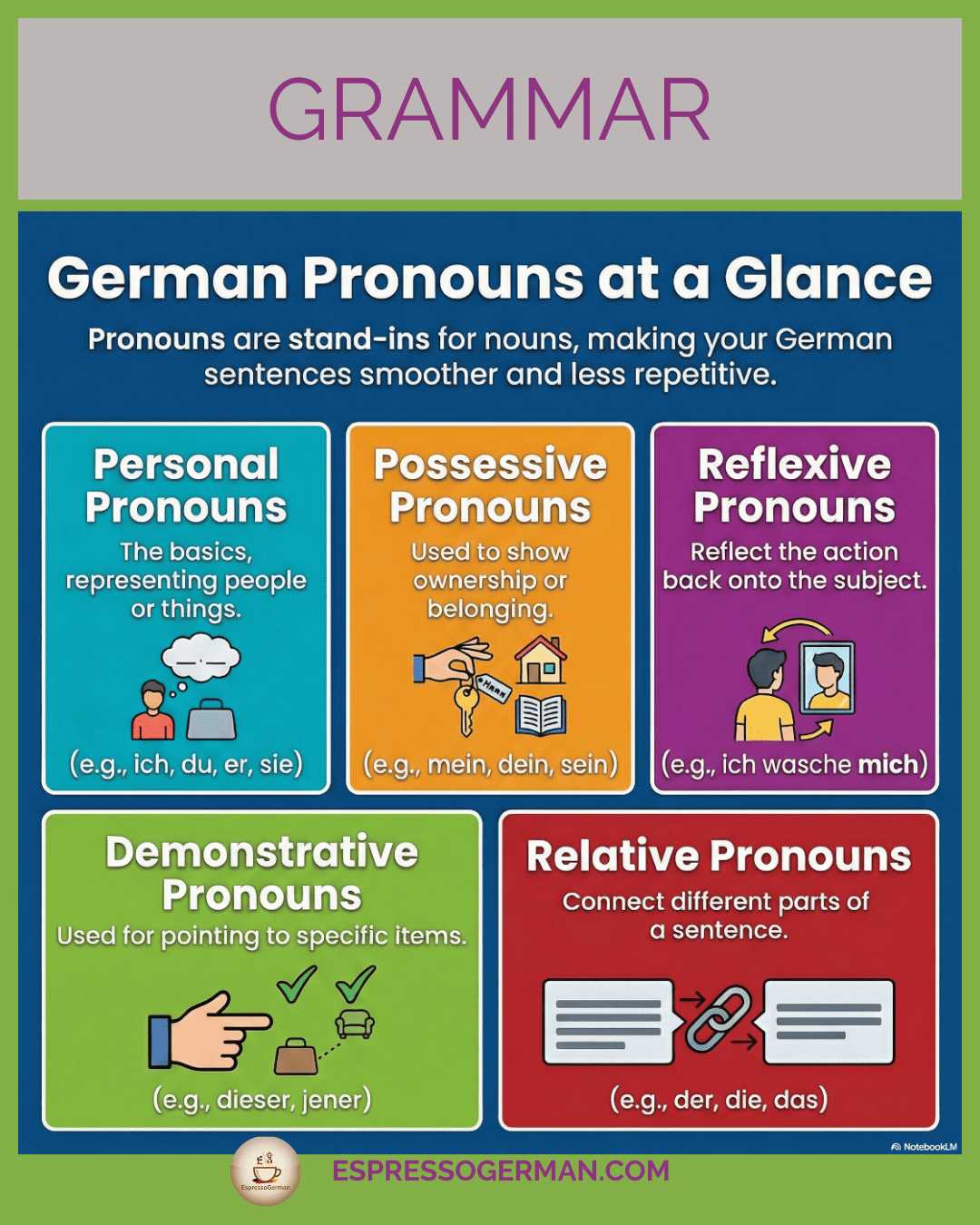
Pronouns (Pro-Nouns) are the stunt doubles of language.
Instead of repeating "The man gave the man's dog to the man's friend," we say "He gave his dog to him."
Without them, we would sound like robots. 🤖
The Big Six Families 🌳
1. Personal Pronouns (The Actors)
Characters in the story.
- ich, du, er, sie, es, wir, ihr, sie.
- "He loves her."
2. Possessive Pronouns (The Owners)
Who owns what?
- mein, dein, sein, ihr, unser, euer.
- "This is my house."
3. Reflexive Pronouns (The Mirrors)
Action reflects back on the doer.
- mich, dich, sich, uns, euch.
- "I wash myself." (Ich wasche mich).
4. Demonstrative Pronouns (The Pointers)
Pointing fingers at specific things.
- dieser, jener, der, die, das.
- "I want that one." (Ich will den da).
5. Indefinite Pronouns (The Ghosts) 👻
Vague people or things.
- jemand (someone), niemand (no one), etwas (something), man (one).
- "Someone is at the door."
6. Relative Pronouns (The Connectors) 🔗
Linking a description to a noun.
- der, die, das, welcher.
- "The man, who is sleeping..." (Der Mann, der schläft...).
Why learn the names?
You don't need to be a linguist. But knowing the difference between "Reflexive" and "Relative" helps you find the right rule when you are stuck.
The Ultimate Cheat Sheet 📝
| Type | Function | Example |
|---|---|---|
| Personal | Subject/Object | Er liebt sie. |
| Possessive | Ownership | Mein Haus. |
| Reflexive | Mirror | Ich wasche mich. |
| Demonstrative | Pointing | Dieser Mann da. |
| Indefinite | Vague | Jemand ist hier. |
| Relative | Connector | Der Hund, der bellt. |
Memorize one example sentence for each type. It acts as an anchor in your brain!
See also...
- Personal Pronouns — Start with the basics.
- Relative Pronouns — The advanced connectors.