
Two-Way Prepositions (Wechselpräpositionen) ↔️🤷♂️
Two-way prepositions (Wechselpräpositionen) can take either Accusative or Dative. The rule is simple: if there is active movement to a new destination (answering 'Wohin?'), use Accusative. If there is no movement or movement within the same area (answering 'Wo?'), use Dative.
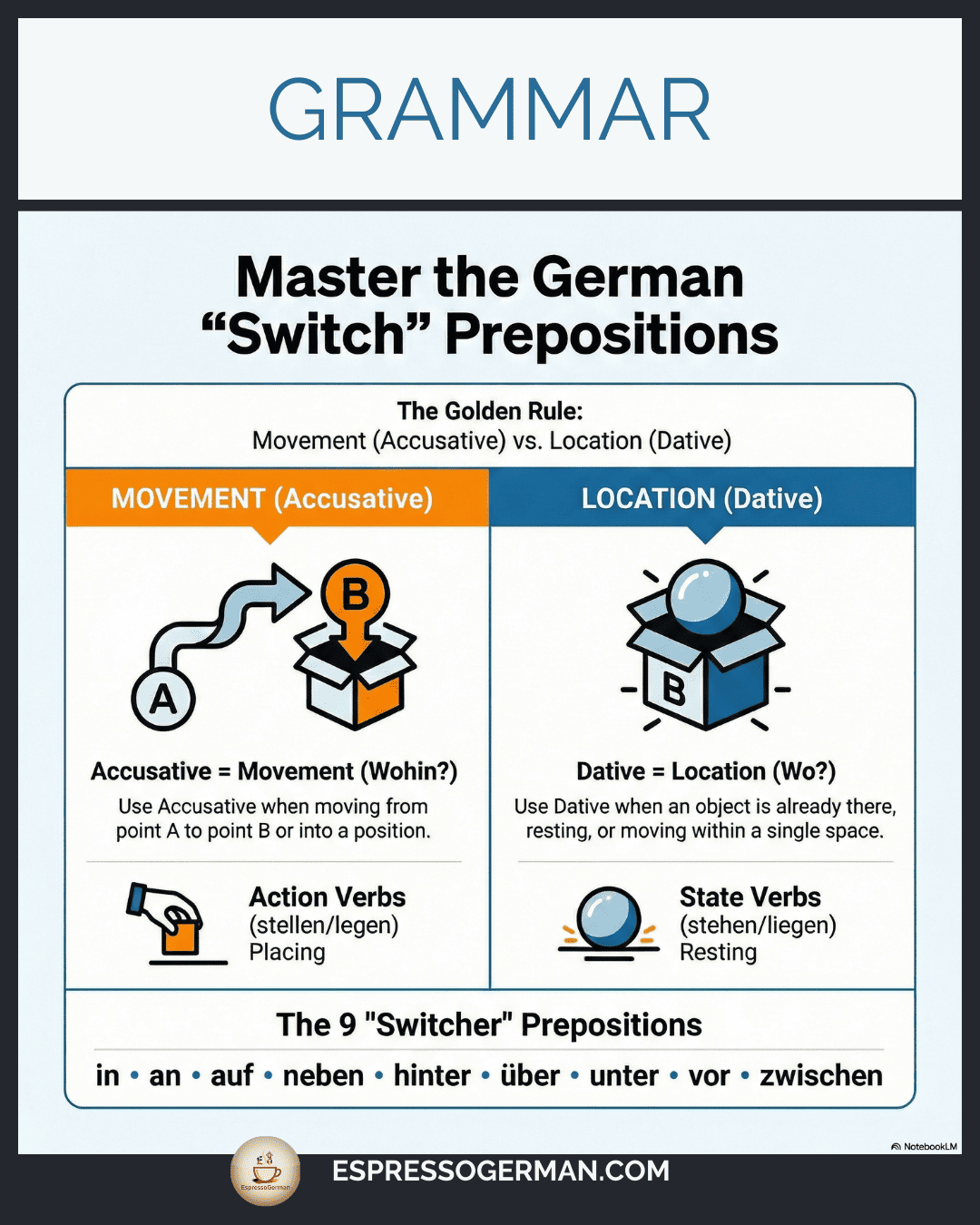
These are the rebels of the preposition world. Sometimes they want the Accusative, sometimes they want the Dative. They "switch" (wechseln) depending on the situation.
The 9 Switchers
in, an, auf, neben, hinter, über,unter, vor, zwischen.
The Golden Rule: Movement vs. Location 🏃♂️ vs. 🧘
To decide which case to use, ask yourself: Is there movement from A to B?
1. The Question "Wohin?" (Where to?) ➔ Accusative
If you are moving into a position or towards something, use Accusative.
- Ich gehe in die Küche. (I go into the kitchen.) — Movement! 🏃♂️
- Ich lege das Buch auf den Tisch. (I lay the book onto the table.) — Action!
2. The Question "Wo?" (Where?) ➔ Dative
If you are already there or moving within the same space, use Dative.
- Ich bin in der Küche. (I am in the kitchen.) — Static! 🧘
- Das Buch liegt auf dem Tisch. (The book lies on the table.) — Resting!
| Preposition | Meaning | Accusative Example (Wohin?) | Dative Example (Wo?) |
|---|---|---|---|
| in | in/into | ins Kino (into the cinema) | im Kino (in the cinema) |
| auf | on/onto | auf den Berg (up the mountain) | auf dem Berg (on the mountain) |
| an | at/on (vertical) | an die Wand (to the wall) | an der Wand (on the wall) |
[!CAUTION]
Thinking verbs vs. Placing Verbs:
- Legen (to lay down - Action) uses Accusative.
- Liegen (to lie/rest - State) uses Dative.
- Stellen (to stand/put - Action) uses Accusative.
- Stehen (to stand - State) uses Dative.
💡 The "Im/Ins" Shortcuts
German loves to combine these:
- in + das = ins
- in + dem = im
- an + das = ans
- an + dem = am
See also...
- Local/Temporal Prepositions — The fixed ones.
- Dative Case — Why Dative means "Stationary."
Ready to practice?
Train your preposition usage!