
Dative Case — The Receiver 🎁
The Dative case marks the indirect object—the person to whom or for whom an action is performed. All articles change in Dative: masculine and neuter become dem/einem, feminine becomes der/einer, and plural becomes den (plus an extra '-n' attached to the noun).
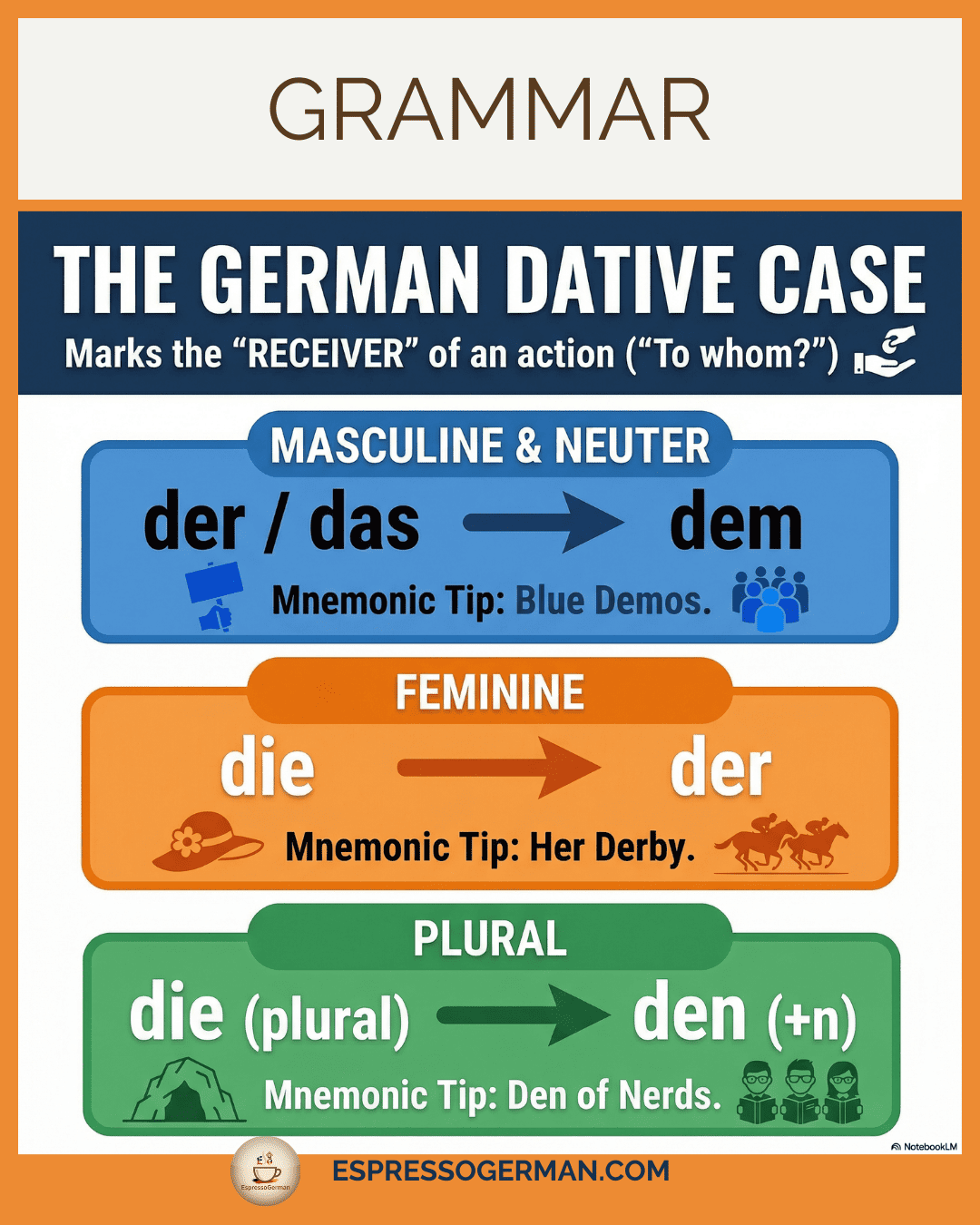
If Accusative is the thing being moved, Dative is the person receiving it.
It answers the question: To whom?
- Ich gebe dem Mann den Apfel. (I give [to] the man the apple).
- Ich = Subject (Nominative)
- den Apfel = Direct Object (Accusative)
- dem Mann = Indirect Object (Dative). He is the receiver.
The Changes (Blue to Blue? No!) 🔵
Dative changes everything.
Think of "Dative" generally as the "M" case (mostly).
| Gender | Definite (The) | Indefinite (A/An) | Personal Pronoun |
|---|---|---|---|
| Masculine | dem Mann | einem Mann | ihm (him) |
| Feminine | der Frau | einer Frau | ihr (her) |
| Neuter | dem Kind | einem Kind | ihm (it) |
| Plural | den Kindern | - Kindern | ihnen (them) |
[!WARNING]
Trap Alert!
- Did you see Feminine? Die becomes Der! Yes, it looks like Masculine Nominative, but it's Dative Feminine.
- Ich helfe der Frau. (I help the woman).
- Plural N: In Dative Plural, you add an extra -n to the noun itself!
- Nominative: Die Kinder.
- Dative: Mit den Kindern.
When do I use it?
1. Indirect Objects (Giving, Sending, Showing)
Verbs that involve a transfer often have both cases.
- geben, schenken, schicken, zeigen, bringen...
- Er schenkt ihr (Dat) einen Ring (Acc).
2. Specific Dative Verbs
Some verbs are "selfish" and skip the Accusative. They interact directly with the person.
- Helfen (to help): Ich helfe dir. (Not dich!)
- Danken (to thank): Ich danke ihnen.
- Folgen (to follow)
- Gefallen (to like/please)
3. Dative Prepositions
These words ALWAYS trigger Dative. Memorize the "Blue Danube" song melody for these (look it up on YouTube):
aus, bei, mit, nach, seit, von, zu (+ gegenüber)
Ich komme aus dem Haus.
Ich spreche mit der Frau. (Not die Frau!).
Word Order: The Golden Rule 🥇
When you have BOTH objects in a sentence, who comes first?
Dative comes before Accusative (usually).
- Ich gebe dem Mann (Dat) den Apfel (Acc).
- (I give the man the apple).
If you switch it (Ich gebe den Apfel dem Mann), it implies emphasis on the MAN. But the standard order is D before A.
See also...
- Genitive Case — The final boss.
- Prepositions — More details on Mit, Bei, etc.
Ready to practice?
Practice your case endings now!