
Imperative — The Boss Mode 👮♂️📢
The Imperative is used for commands or requests. There are three forms: informal singular (drop the -st: Komm!), informal plural (same as present tense: Kommt!), and formal (verb + Sie: Kommen Sie!). Vowel changes apply to strong verbs in the singular form.
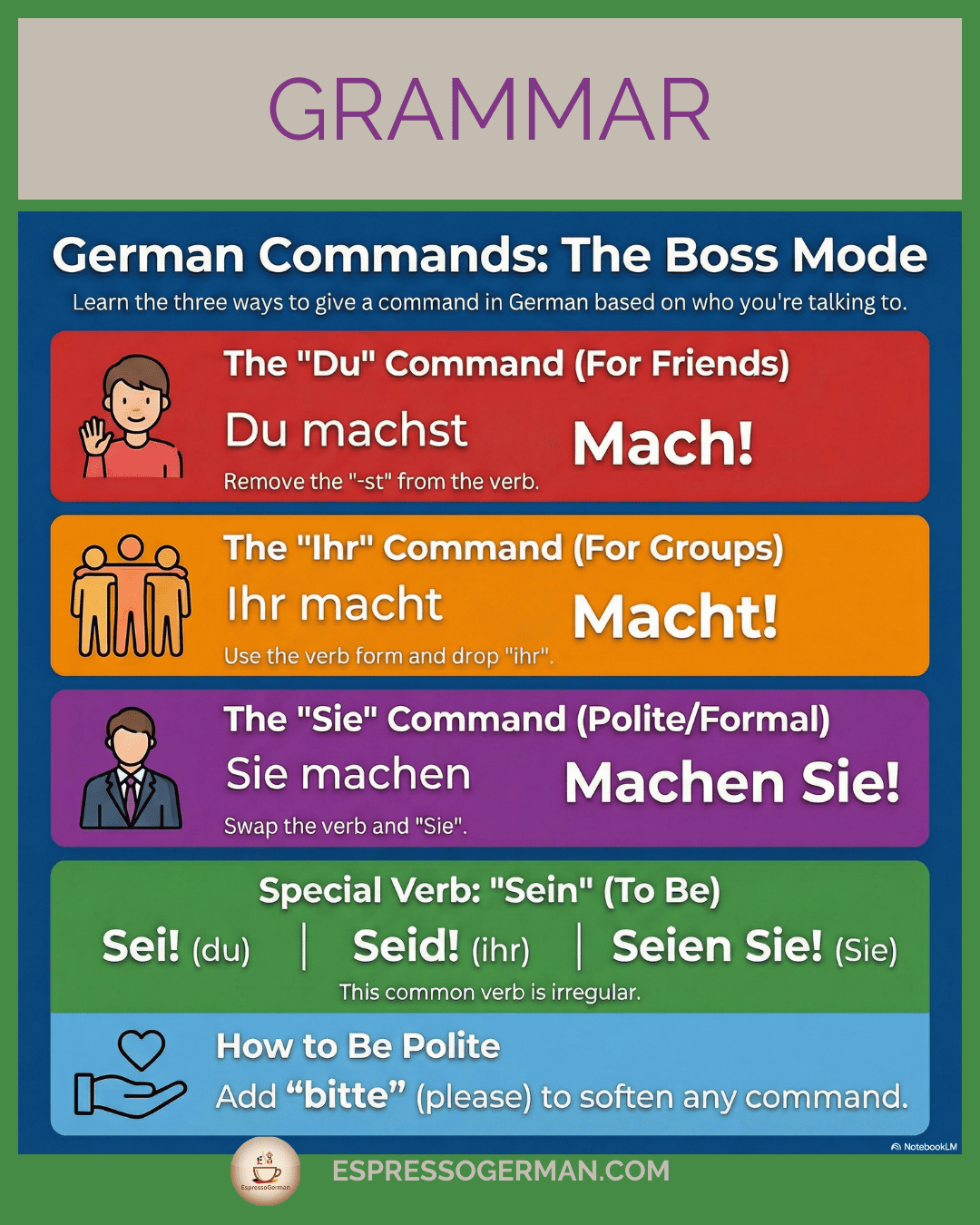
When you want to give orders. "Eat!" "Stop!" "Be quiet!"
In German, we have three levels of bossiness tailored to who you are talking to.
1. The "Du" Command (Friends) 🤜🤛
Remove the st from the Du-form.
- Du machst. -> Mach!
- Du gehst. -> Geh!
- Du isst. -> Iss! (Keep the vowel change e->i).
- Du fährst. -> Fahr! (Remove Umlaut ä->a).
Mach das Fenster auf! (Open the window!)
2. The "Ihr" Command (Group of Friends) 👨👩👧👦
This is easy. Just use the normal Ihr form but drop the "Ihr".
- Ihr macht. -> Macht!
- Ihr geht. -> Geht!
- Ihr esst. -> Esst!
Macht eure Hausaufgaben! (Do your homework, kids!)
3. The "Sie" Command (Polite) 🎩
The most polite command. You keep the pronoun Sie but swap the order.
- Sie machen. -> Machen Sie!
- Sie gehen. -> Gehen Sie!
Kommen Sie bitte herein. (Please come in.)
The Irregular "Sein" (To Be) 🦄
Sein is always weird.
- Du: Sei leise! (Be quiet!)
- Ihr: Seid leise!
- Sie: Seien Sie leise!
Common Mistakes ⚠️
- Don't say "Du"! In the Du-Imperative, the word Du disappears.
- Gehst du nach Hause! (Wrong - Statement).
- Geh nach Hause! (Correct - Command).
- The "Sie" Position: For Sie, the Sie must stay, but moves after the verb.
- Sie essen. (Statement).
- Essen Sie! (Command).
- Bitte: Germans use Bitte to soften commands.
- Gib mir das Salz, bitte. (Give me the salt, please).
Fun Fact 🤓
Sometimes you will see an "e" at the end of Du-commands in old books.
- Gehe! instead of Geh!
This is old-fashioned ("Luther-German"). Today, we drop the "e".
See also...
- Verbs Basics — Conjugation rules.