
Participles — Turning Verbs into Adjectives 🔄
German participles can function as adjectives. Present participles (infinitive + d) describe ongoing actions (das weinende Kind - the crying child). Past participles describe completed actions (das gestohlene Auto - the stolen car). Both must take standard adjective declension endings.
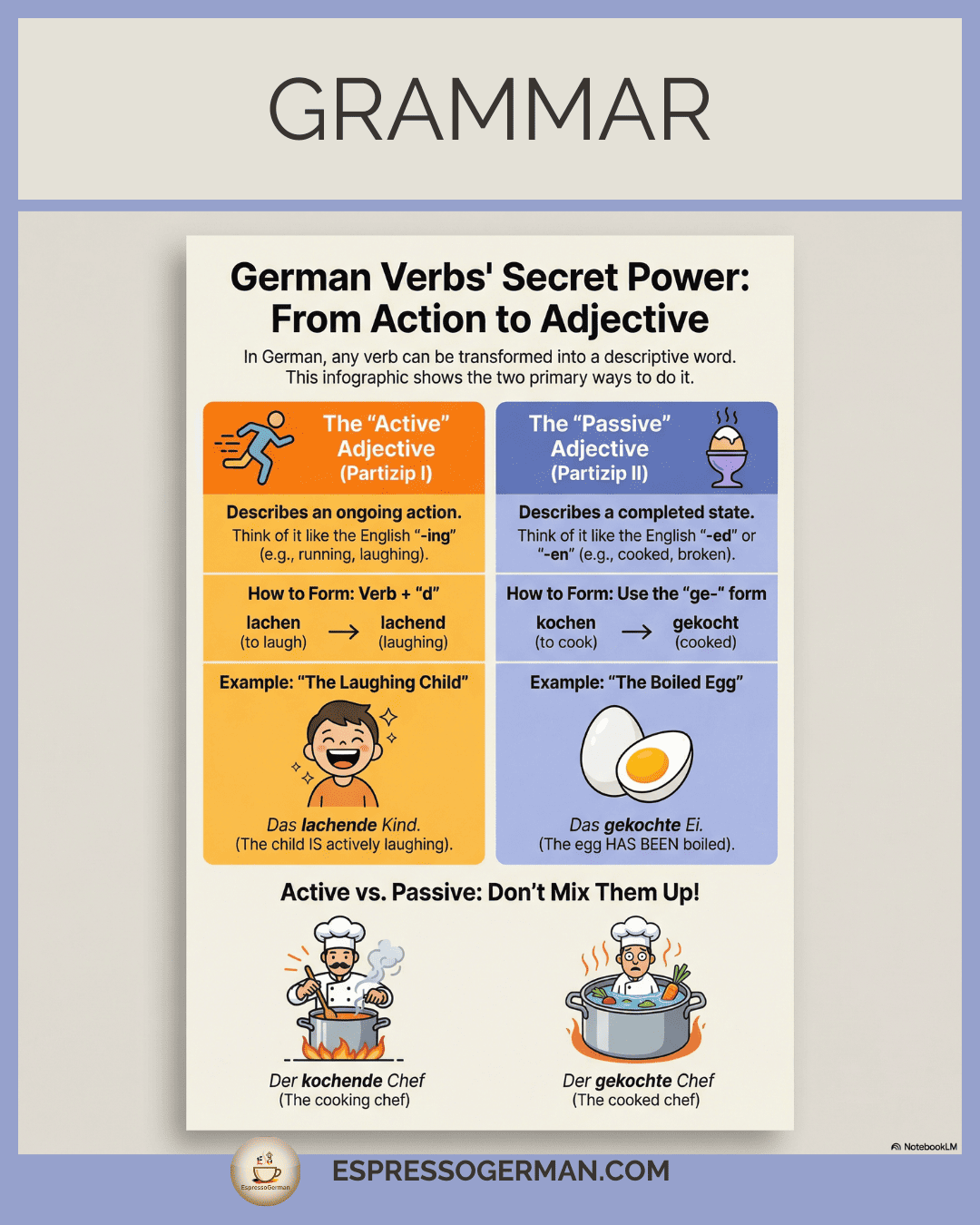
Did you know every verb in German is secretly an adjective waiting to happen?
It’s like a magic trick. You take an action (laufen - to run) and turn it into a description (laufend - running).
This is super useful because it lets you describe things by what they are doing or what happened to them.
1. Present Participle (Partizip I) — The "Active" One 🏃
How to form it: Take the Infinitive (machen, gehen) and add a -d.
- lachen ➔ lachend
- rennen ➔ rennend
What it means: Something is actively doing this action right now.
Think of it like the English "-ing" form (laughing, running).
Examples
- Das lachende Kind. (The laughing child - The child IS laughing).
- Der bellende Hund. (The barking dog).
- Die aufgehende Sonne. (The rising sun).
[!NOTE]
Notice the endings? Once it becomes an adjective (lachend), you have to add the normal adjective endings (-e, -en, -er) depending on the noun!
- Ein lachendes Kind (Mixed declension!)
2. Past Participle (Partizip II) — The "Passive" One 🍳
How to form it: It's the standard "ge-" form you use for perfect tense (gemacht, gegangen).
- kochen ➔ gekocht
- reparieren ➔ repariert
What it means: The action happened TO the object. It is a completed state.
Think of it like the English "-ed" or "-en" adjectives (cooked, broken).
Examples
- Das gekochte Ei. (The boiled egg - Someone boiled it).
- Das reparierte Auto. (The repaired car).
- Die geschlossene Tür. (The closed door).
Comparison:
- Der kochende Chef (Partizip I: The chef is actively cooking).
- Die gekochte Suppe (Partizip II: The soup was cooked).
3. The "German Sandwich" (Extended Modifiers) 🥪
Here is where German shows off. You can stuff an entire mini-sentence INSIDE the adjective phrase.
English: The man [who is reading the book]...
German: The [book reading] man...
- Der Mann liest das Buch.
- ➔ Der [das Buch lesende] Mann.
How to build it:
- Start with the Article (Der).
- Pack all the extra info (das Buch, auf dem Sofa, gestern).
- End with the Participle + Ending (lesende).
- Finally, the Noun (Mann).
More Examples:
- Das [auf dem Tisch stehende] Glas. (The glass standing on the table).
- Die [von meiner Oma gestrickten] Socken. (The socks knitted by my grandma).
[!TIP]
Don't panic when you see these long constructions in books. Just look for the Article at the start and the Noun at the end. Everything in between is just a fancy description!
FAQ 🙋
Q: Can I use them as Adverbs?
A: Yes! If you don't put them before a noun, they don't need an ending.
- Er rannte lachend weg. (He ran away laughing).
- Er kam gestresst nach Hause. (He came home stressed).
Q: Are there irregular Partizip I forms?
A: Almost never! Even irregular verbs behave well here. Sein (to be) ➔ seiend. Tun (to do) ➔ tuend. The only weird one is hoch -> die hohe Mauer (adjective) vs das höhende... (wait, strictly speaking hohen is not a verb). But laufen -> laufend is super safe.
Common Pitfalls ⚠️
- ❌ The "Zu" Mistake: Thinking you need "zu" (to) here. Das zu lachende Kind. NO! Just Das lachende Kind.
- ❌ Mixing Active/Passive: Der gekochte Chef (The cooked chef... ouch!) vs Der kochende Chef (The cooking chef). Be careful!
Now you can create adjectives out of thin air! Use this power wisely. 🧙♂️
See also...
- Adjective Endings — How to decline them.