
Comparison of Adjectives — Good, Better, Best 🏆
To compare in German, add -er for the comparative (schneller - faster) and -(e)st for the superlative (am schnellsten - fastest). Short adjectives often gain an umlaut (kalt -> kälter). Use 'als' (than) for comparatives and 'so... wie' (as... as) for equals.
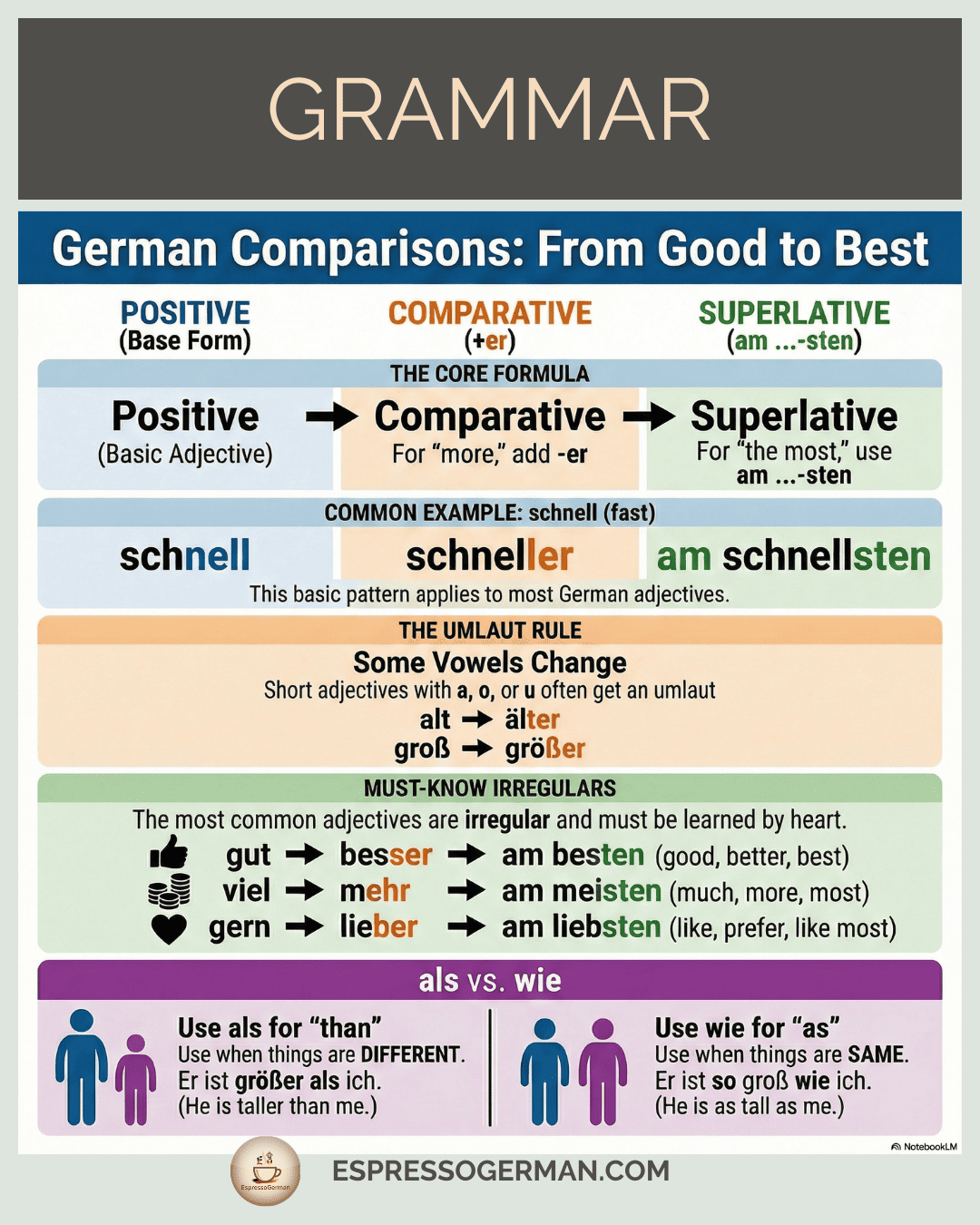
So you want to say that something is bigger, faster, or more expensive than something else? Or maybe even the best? Welcome to the world of comparisons! 🌍
In German, this topic is refreshingly logical (mostly). If you know how to do it in English, you're already 80% there. But of course, we have a few Umlauts and special endings to spice things up. 🌶️
1. The Comparative (Komparativ) 🚀
To say something is "more X", you simply add -er to the adjective. That's it!
- schnell (fast) ➔ schneller (faster)
- klein (small) ➔ kleiner (smaller)
- billig (cheap) ➔ billiger (cheaper)
[!TIP]
No "more" logic! In English, we say "more honest" or "more exciting". In German, we usually just stick -er on everything.
- interessant ➔ interessanter (NOT: mehr interessant)
- aufregend ➔ aufregender
The Umlaut Upgrade ̈
Some short, one-syllable adjectives with a, o, u get an Umlaut in the comparative. Sounds fancy, right?
- alt ➔ älter (older)
- groß ➔ größer (bigger)
- jung ➔ jünger (younger)
- kurz ➔ kürzer (shorter)
- klug ➔ klüger (smarter)
2. The Superlative (Superlativ) 🥇
When something is the absolute most, you have two ways to say it, depending on how you use it in the sentence.
Variant A: "Am ...-sten" (The adverbial way)
Use this when you say "X is the best." (at the end of the sentence or as a predicate).
- schnell ➔ am schnellsten
- Dieser Zug ist am schnellsten. (This train is the fastest.)
- Ich trinke Kaffee am liebsten schwarz. (I like drinking coffee black the most.)
Variant B: The Definite Article (The attributive way)
Use this when the adjective sits right in front of a noun. It needs a declension ending (usually -e, sometimes -en).
- der schnell*ste Zug* (the fastest train)
- die schön*ste Frau* (the most beautiful woman)
- das klein*ste Haus* (the smallest house)
3. Irregular Adjectives (Cheat Sheet) 🕵️♀️
There are only a handful, but they are used all the time. Memorize these!
| Adjective | Comparative (-er) | Superlative (am ...-sten) | Meaning |
|---|---|---|---|
| gut | besser | am besten | good / better / best |
| viel | mehr | am meisten | much / more / most |
| gern | lieber | am liebsten | like / prefer / like most |
| hoch | höher | am höchsten | high / higher / highest |
| nah | näher | am nächsten | near / nearer / nearest |
[!NOTE]
Hoch is weird: The 'c' drops in the comparative (höher), but comes back in the superlative (am höchsten).
4. Comparing: "Als" vs. "Wie" ⚖️
This is the classic mistake even native speakers make. Here is the strict rule:
DIFFERENT? Use "als" (than)
If A is bigger/smaller/better than B, use als.
- Er ist größer als ich. (He is taller than me.)
- Berlin ist teurer als Leipzig.
SAME? Use "wie" (as)
If A is exactly the same as B, use so ... wie.
- Er ist so groß wie ich. (He is as tall as me.)
- Dein Auto ist so schnell wie meins.
FAQ: Frequently Asked Questions 🙋♂️
Q: Can I say "mehr gut" instead of "besser"?
A: No! Just like you wouldn't say "more good" in English. It's always besser.
Q: Why is it "am besten" but sometimes "das Beste"?
A: Am besten is for "It is the best" (adverbial). Das Beste is used when "Best" acts like a noun (The Best thing). E.g., Ich wünsche dir das Beste! (I wish you the best!).
Q: Do I always need an Umlaut for a/o/u?
A: Not always! Bunt (colorful) becomes bunter (not bünter). But for the most common ones like alt, jung, groß, kurz, yes.
Common Pitfalls ⚠️
- ❌ The "Wie" Mistake: Saying "Er ist größer wie ich." (Dialect often does this, but in standard German, it's wrong!). Correct: größer als.
- ❌ The "Am" Drop: Saying "Er ist schnellsten." Missing the am! Correct: Er ist am schnellsten.
- ❌ The "Mehr" Trap: Using mehr for adjectives like "mehr interessant". Stick to interessanter.
Now you are ready to brag in German! Go be am besten! 🌟
See also...
- Adjective Endings (Basic) — If you need to decline them.