
Adjective Endings 101 — The Survival Guide 🧭
When an adjective sits before a noun (and directly after a definite article like 'der'), it must take an ending. In the Nominative case, this ending is usually just -e (der gute Mann, die nette Frau). In the Accusative, the masculine changes to -en.
Welcome to the topic that gives German learners nightmares: Adjective Endings. 😱
But wait! Put down the pitchforks. It’s actually not random. There is a logic behind the madness, and once you see it, you can't unsee it.
We will break this into two parts: Basic (this page) and Advanced (the tables). Let's start with the survival concepts.
The Golden Rule: The "Signal" 📡
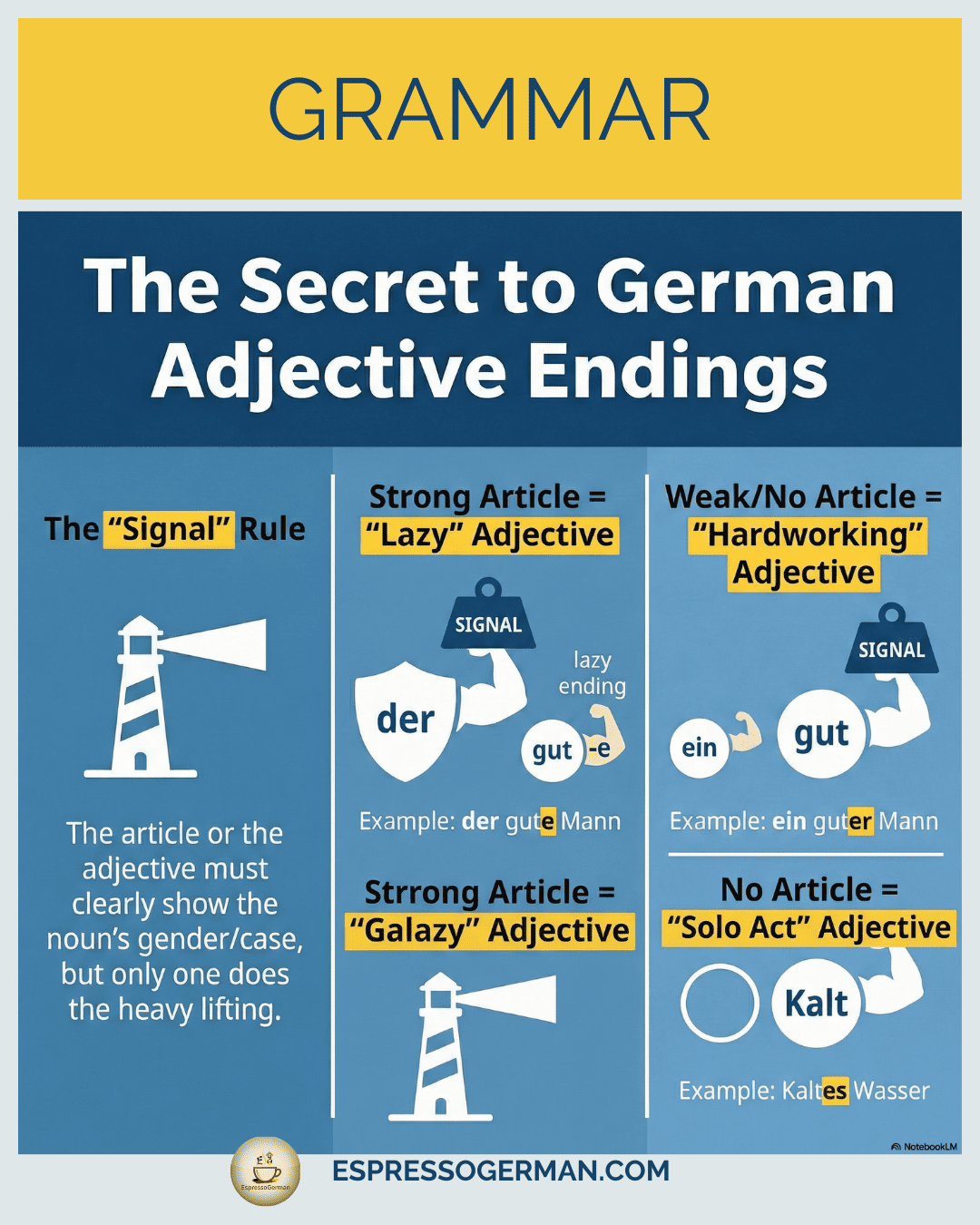
Here is the secret: The Gender/Case signal must be shown exactly ONCE.
Think of it like a relay race.
- The Article (der, die, das) holds the baton (the signal).
- If the Article checks in and shows the signal clearly, the Adjective can be lazy and just add a boring -e or -en.
- If there is no Article (or a "weak" one like ein), the Adjective must step up and carry the baton itself (by taking the strong ending like -er, -es).
Scenario A: The Lazy Way (With Definite Articles) 😴
Words: der, die, das, dieser, jener, welcher, jeder
These articles are strong. They show the gender clearly.
- Der Mann (Masculine? Check.)
- Das Kind (Neuter? Check.)
Because the article does the work, the adjective just takes a "Weak Ending."
The Weak Endings are simple: It's either -e or -en.
The "Five-E" Rule
There are only 5 situations where you use -e. Everything else is -en.
| Case | Masculine | Feminine | Neuter | Plural |
|---|---|---|---|---|
| Nom | der gute | die gute | das gute | die guten |
| Acc | den guten | die gute | das gute | die guten |
| Dat | ...en | ...en | ...en | ...en |
| Gen | ...en | ...en | ...en | ...en |
Key Takeaways:
- Dative, Genitive, Plural = ALWAYS -en. (Easy!)
- Masculine Accusative (den) = -en.
- The only -e survivors are Singular Nominative (and Fem/Neut Accusative).
Scenario B: The Helping Hand (With Indefinite Articles) 🤝
Words: ein, eine, mein, dein, kein
Sometimes, the article is a bit "weak". Look at ein.
- ein Mann (Could be masculine... or neuter?)
- ein Kind (Could be neuter... or masculine?)
The word ein has no ending here. It dropped the baton! 🚩
So the Adjective must pick it up and show the signal.
- ein gut*er Mann* (The -er shows it's Masculine Der).
- ein gut*es Kind* (The -es shows it's Neuter Das).
- eine gut*e Frau* (The -e shows it's Feminine Die - eine actually helps here, but we match it).
[!TIP]
This is called "Mixed Declension". Most of the time it looks like the Definite Article table (-en everywhere), but for the Nominative/Accusative singular, the adjective has to show the gender.
Scenario C: The Solo Act (No Article) 🎸
Examples: Cold water, Fresh milk, German beer
If there is NO article at all, the Adjective is the star of the show. It MUST carry the full signal. It takes the ending the article would have had.
- kalt*es Wasser* (like das Wasser)
- frisch*e Milch* (like die Milch)
- deutsch*er Wein* (like der Wein)
FAQ: Why do I need to know this? 🤷♀️
Q: Can't I just mumble the ending?
A: You can, and people will understand you. But getting this right is the difference between "I speak German" and "I speak German well."
Q: Is "ein gutes Mann" wrong?
A: Yes! Mann is masculine. Das (neuter) would be es. Der (masculine) is er. So it must be ein gut*er Mann*.
Common Pitfalls ⚠️
- ❌ Saying ein gut Mann (Missing ending! Ein has no ending, so adjective needs one).
- ❌ Saying die guten Leute in Nominative? Wait, actually that is Correct! Plural always takes -en after an article.
- ❌ Forgetting the -n in the Dative. Mit dem netten Mann (Correct). Mit dem nette Mann (Wrong).
Ready for the full breakdown? Check out the Advanced tables.
See also...
- Advanced Declension — The full tables.
Ready to practice?
Perfect your adjective endings!