

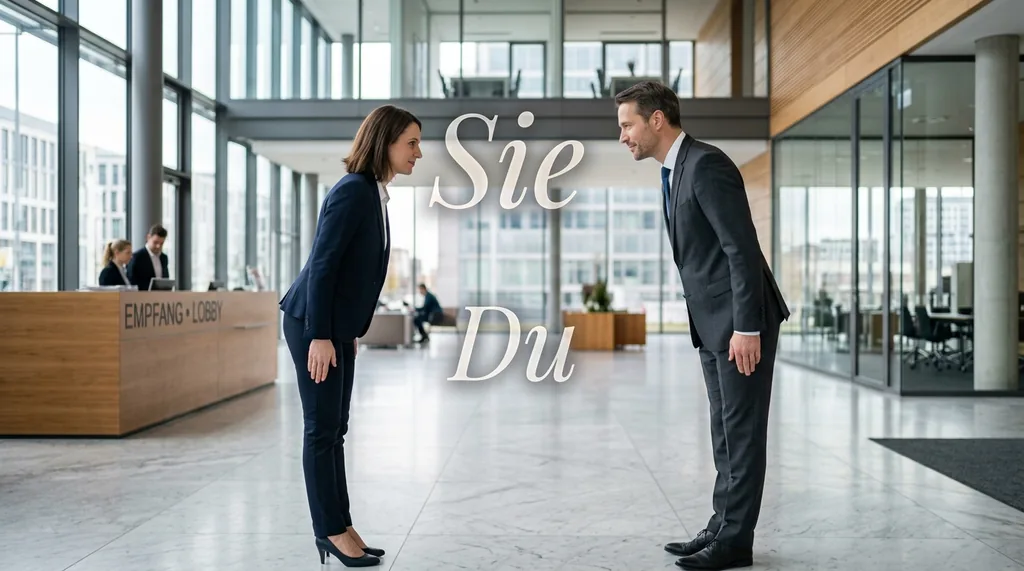
If you are learning German, you’ve likely felt the "pronoun panic." You’re about to speak to your neighbor, your boss, or the person at the bakery, and you freeze. Do you use the friendly Du or the respectful Sie?
This isn't just a grammar rule; it’s a social contract. Using the wrong one can make you sound either overly stiff or accidentally rude. While the "Du-culture" is growing in modern Germany (especially in tech and startups), the rules for 2026 are still quite specific.
Here is the EspressoGerman decision-tree to help you choose the right "You" every time.
The "Sie" (Formal) Rules
Sie is the "default" for adults who don't know each other. It creates a respectful distance.
Use "Sie" if:
The person is a stranger: Shop assistants, police officers, doctors, or someone you're asking for directions.
The person is significantly older: Even if you’ve lived next to your 80-year-old neighbor for years, stick to Sie unless they explicitly tell you otherwise.
The situation is professional: In traditional industries (Law, Finance, Government), Sie is the iron-clad rule.
You are in doubt: It is always better to be "too formal" than "too casual." No one is offended by being called Sie, but some may be offended by an uninvited Du.
The "Du" (Informal) Rules
Du is the language of closeness, family, and equality.
Use "Du" if:
The person is a child: Anyone under 16 always gets a Du.
The person is a friend or family member: Once you’ve been invited to the "inner circle."
The setting is a "Du-Zone": Some environments, like IKEA, sports clubs (Vereine), or heavy metal concerts, have a universal Du policy.
You are at a Startup: In 2026, most tech companies and creative agencies in Berlin or Munich use Du from the CEO down to the intern.
The 2026 Decision-Tree
To simplify your life, follow this mental flowchart:
- Are they a child?
- Yes -> Du
- No -> Go to 2
- Are they a close friend or family?
- Yes -> Du
- No -> Go to 3
- Are you at work?
- Yes -> Look at the boss. Does everyone say Du? If yes -> Du. If unsure -> Sie.
- No -> Go to 4
- Are you in a service situation (Restaurant/Bank/Doctor)?
- Yes -> Sie
- No -> Sie (Safe bet!)
The Golden Rule: "Das Du anbieten"
How do you move from Sie to Du? In German culture, the higher-ranking or older person must "offer" the Du.
If you are a junior employee, wait for your boss to say: "Wir können uns gerne duzen" (We can happily use 'du' with each other). Once that happens, there is no going back—you are officially on a Du-basis!
Grammatical Reminder
Don't forget that changing your pronoun changes your verb!
Sie: "Wie heißen Sie?" / "Kommen Sie aus Berlin?"
Du: "Wie heißt du?" / "Kommst du aus Berlin?"
What is the weirdest "Du vs. Sie" moment you’ve had? Have you ever accidentally called your boss Du or your best friend's mom Sie? Log in and share your social "Fauxpas" stories below!

Comments
Please log in to leave a comment.